Tag: india

  • Currency: Persian Gulf Notes

    A Persian Gulf Quartet — Finally Graded & Together

    Government of India / Reserve Bank of India Persian Gulf notes — ₹1, ₹5, ₹10 and ₹100 — are now all authenticated and graded, with the final two notes recently returning from grading.

    The grades may look modest:

    ₹1 — PMG 25 Very Fine
    ₹5 — PMG 20 Very Fine
    ₹10 — PMCS 25 Very Fine
    ₹100 — PMG 15 Choice Fine

    But with notes such as these, the number on the holder tells only part of the story.

    These are survivors of a fascinating episode in Indian monetary history.

    Introduced for circulation in the Persian Gulf region, these special Indian rupee notes are immediately recognisable to collectors by their distinctive “Z” prefix. They circulated in places including Kuwait, Bahrain, Qatar and the Trucial States — the region that would later include the United Arab Emirates.

    For someone who has spent much of his life in the UAE while retaining deep roots in India, that historical connection makes this series particularly special to me. 🇮🇳🤝🇦🇪

    And then there is the reality of collecting them.

    Finding attractive examples is not easy. These notes actually circulated, and surviving pieces often show folds, handling, staple holes and other evidence of their working life

    A pristine note is beautiful. But a circulated note can have a biography.

    Imagine where these pieces might have travelled more than six decades ago — across counters, markets and trading houses around the Gulf, passing through hands in a region that was about to undergo an extraordinary transformation.

    And today, they sit together in my collection.

    For me, therefore, this little group isn’t about chasing a 60, 65 or 67 grade.

    It is about history, survival, geography and completing a difficult set.

    The grading is simply the finishing touch: authentication, protection and preservation for the years ahead. “This set was not acquired together. I built it patiently, one denomination at a time, over the course of nearly a year. That makes seeing all four — ₹1, ₹5, ₹10 and ₹100 — finally graded and together particularly satisfying.”

    And yes… after hunting for the missing pieces and finally getting the balance two graded, there is considerable satisfaction in being able to say:

    ₹1. ₹5. ₹10. ₹100.
    Persian Gulf Issue.
    Together at last.

  • Old Coins: Princely States

    • Featured today: coins representing the rich history of Indian princely states before and during British rule.

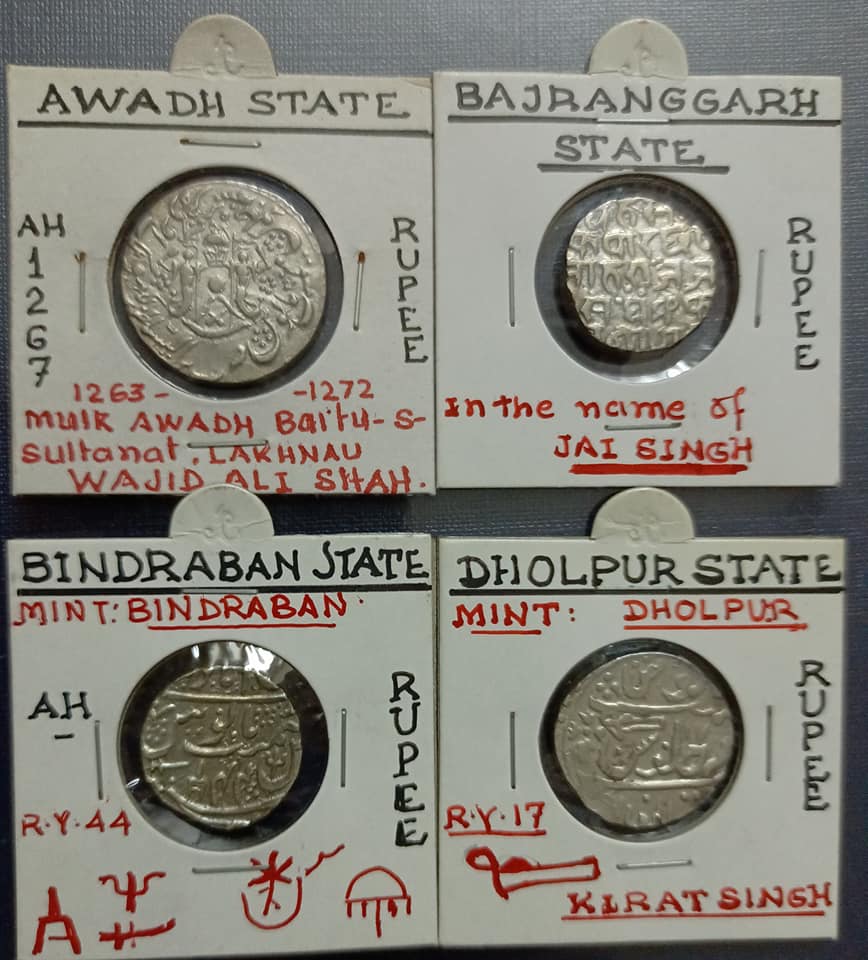
    1. Awadh State Coin

    • Period: 1263-1272 (Islamic calendar, likely 1847-1855 AD)

    • Mint: Lucknow

    Ruler: Wajid Ali Shah (the last Nawab of Awadh)

    • Details: This coin was issued during the rule of Wajid Ali Shah, the last ruler of the Awadh kingdom before its annexation by the British East India Company in 1856.

    2. Bajranggarh State Coin

    • Issued in the name of Jai Singh

    • Details: Bajranggarh was a small princely state, and this coin was likely minted in a local or regional style.

    3. Bindraban State Coin

    • Mint: Bindraban (Vrindavan)

    • Islamic Year: AH (Anno Hegirae)

    • Ruler: Not specified

    • Details: Bindraban (modern-day Vrindavan) was a prominent religious and cultural hub during the Mughal and British periods.

    4. Dholpur State Coin

    • Mint: Dholpur

    • Reign Year: RY 17

    • Ruler: Kirat Singh

    • Details: Dholpur was a princely state in present-day Rajasthan, and this coin was likely issued during Kirat Singh’s rule.

    ________________________________________

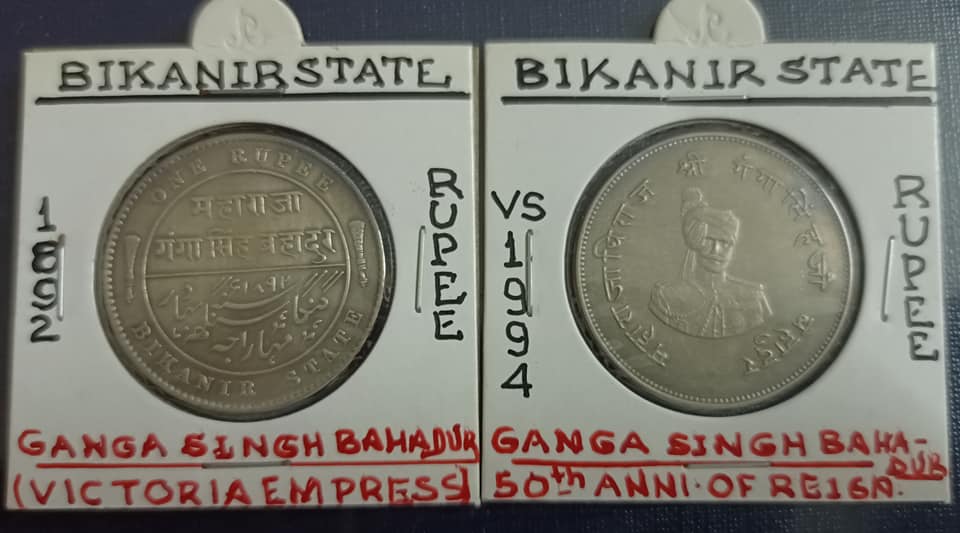
    5. Bikaner State Coins

    • Coin 1 (1892)

    o Ruler: Ganga Singh Bahadur

    o Inscription: Mentions Victoria Empress

    o Details: This coin signifies the relationship between Indian princely states and British rule.

    • Coin 2 (VS 1994)

    o 50th Anniversary of Ganga Singh Bahadur’s reign

    o Details: This commemorative coin marks an important milestone in his rule.

    ________________________________________

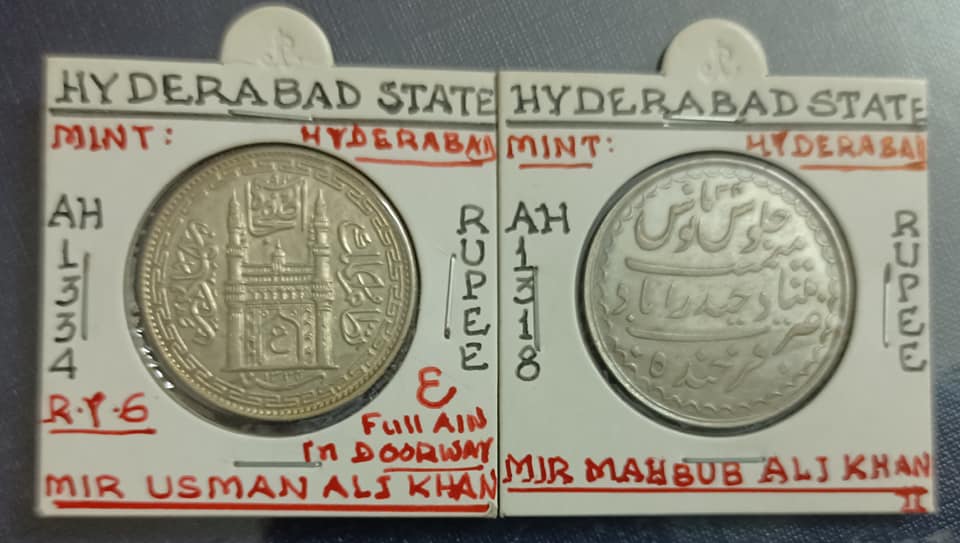
    6. Hyderabad State Coins

    • Mint: Hyderabad

    • Coin 1:

    o Reign: Mir Usman Ali Khan (last Nizam of Hyderabad)

    o Distinct Feature: Depiction of Charminar on one side.

    • Coin 2:

    o Reign: Mir Mahbub Ali Khan

    o Details: Hyderabad was one of the most powerful and wealthy princely states under British India.

    ________________________________________

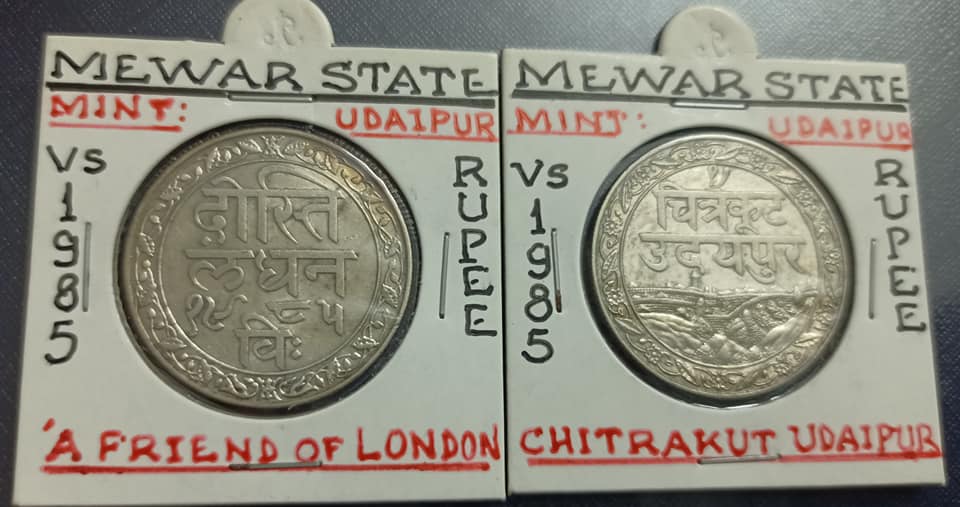
    7. Mewar State Coins

    • Mint: Udaipur

    • Coin 1 (VS 1985)

    o Inscription: “A Friend of London”

    o Details: This could indicate British influence in the region.

    • Coin 2:

    o Design: Chitrakut Udaipur (depicting a scenic view of Udaipur)

    o Details: Mewar, centered around Udaipur, was a historic Rajput kingdom known for its fierce resistance against Mughal and British rule.