Blog

  • Currency note: The “Phaphda Note” — When Currency Met Culture

    Among the many treasures from the past, some stand out not just for their value, but for the stories they quietly carry.

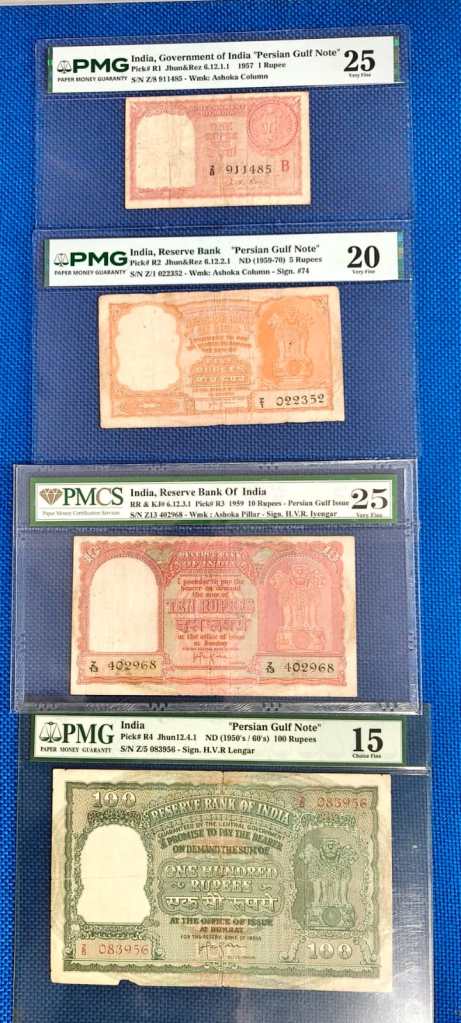
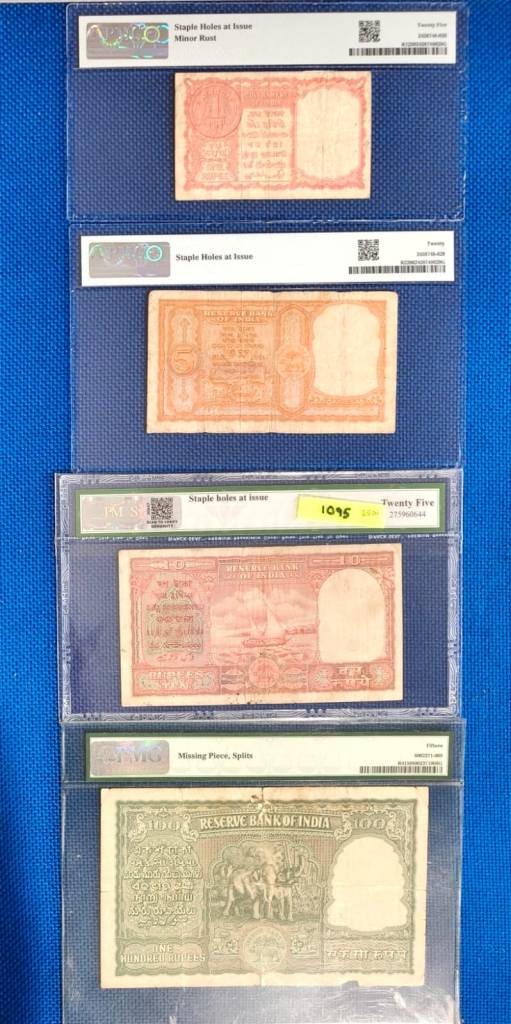
    This ₹100 note from the Reserve Bank of India, dating back to the 50’s era of King George VI, is fondly nicknamed the “Phaphda Note” by collectors — thanks to the large watermark window that amusingly resembles the famous Gujarati snack! Signed by H.V.R. Iyengar, it’s from the AA series, i.e. an early prefix .

    But beyond the nickname lies a piece of history.
    Issued at a time when ₹100 was a significant sum, these notes were not widely circulated, making surviving examples quite special today.

    The front proudly displays the Ashoka Pillar — even before it became India’s national emblem — while the reverse showcases a majestic dam, symbolizing the nation’s early strides in infrastructure and progress.

    With its intricate design, multilingual script panel, and old-world charm, this note is more than currency — it is a snapshot of a transitioning India.

    A little worn, yes… but then again, history rarely stays crisp. 🙂

  • India in Coins – A Journey Through Time & Tribute

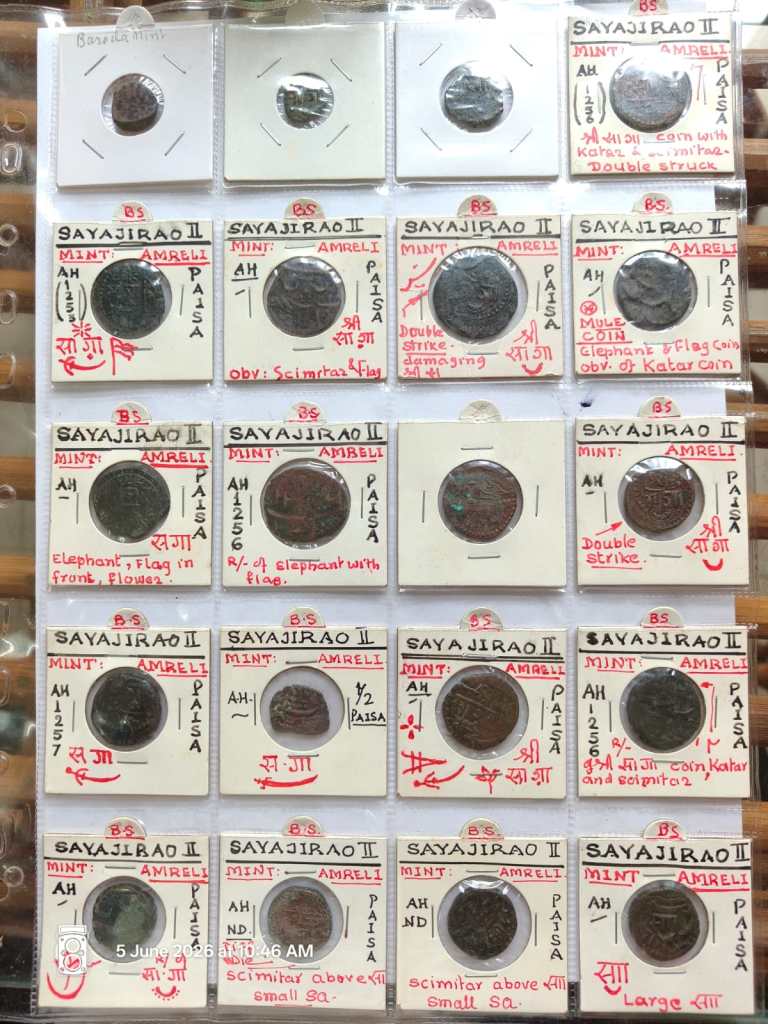
    From the early decades of independence to modern commemoratives, this page from the collection beautifully captures how India told its story… not in books, but in coins. ..I remember most of these coins, many were in normal use.

    Each piece here is more than currency — it’s a moment frozen in metal.

    ✨ Highlights from the Collection

    🔹 Ashoka Lion Capital Series
    A recurring symbol of India’s identity, seen across denominations — representing authority, continuity, and national pride.

    🔹 FAO Issues (Food & Agriculture Organization)
    Coins like Grow More Food and Fisheries reflect a time when India was focused on self-sufficiency and agricultural growth.

    🔹 Commemorative Leaders

    Jawaharlal Nehru

    Indira Gandhi

    Mahatma Gandhi (Birth Centenary)
    These coins are mini memorials — issued to honor leaders who shaped modern India.

    🔹 National Events

    25 Years of Independence 🇮🇳

    50 Years of Independence

    National Integration

    Asian Games

    Each one marks milestones that defined the country’s journey.

    🔹 The Classic Workhorse – 10 Paise Series
    That iconic scalloped shape — a childhood legend!
    Light in weight, heavy in memories.

    This is about about storytelling through coins:

    👉 Agriculture to industry
    👉 Leadership to legacy
    👉 Independence to identity

  • Coins: World Commemorative Coins from Dad’s Collection

    Among the many treasures in my father’s collection are these fascinating modern commemorative coins from small island territories and collector-issuing nations. Though modest in face value, they carry themes that are global in appeal — royalty, remembrance, marine life, and the art of modern minting.

    This single page brings together four very different pieces, each with its own story.

    Niue, 1 Dollar, 1997 – Princess Diana Memorial

    The first coin is a 1997 one dollar issue from Niue, a small Pacific island state in free association with New Zealand. It was issued as a memorial tribute to Diana, Princess of Wales, whose death in 1997 led to commemorative issues across many parts of the world.

    One side carries Diana’s portrait, while the other shows the coat of arms design associated with the issuing authority.

    Palau, 1 Dollar, 2001 – Marine Life Protection

    The Palau one dollar coin dated 2001 is perhaps the most visually striking piece in this group. It is a colourized commemorative coin, featuring a marine life theme, and immediately stands out for its vivid underwater design.

    Palau became well known among collectors for issuing attractive modern thematic coins, especially those linked to nature and ocean life. This piece reflects that trend beautifully.

    Nightingale Island, 1 Crown, 2005 – Queen Mother

    The 2005 one crown from Nightingale Island is another evocative modern commemorative. It features a coloured portrait of the Queen Mother and belongs to the category of collector-oriented crown issues associated with remote British island territories.

    Nightingale Island, part of the Tristan da Cunha group in the South Atlantic, is one of those names that instantly sparks curiosity. Coins from such places often appeal to collectors because of their unusual origin as much as their design.

    To summarize, these coins indicate the rise of collector-themed world issues, created as much for display and sentiment as for commerce.

    And honestly, that is part of their charm. A Pacific island remembers Diana. Palau celebrates marine life in colour. A remote Atlantic island honours the Queen Mother. Tiny coins, big geography, bigger stories.

  • Coins: The Simpsons

    Continuing the Simpsons saga..A licensed Simpsons-themed coin album, issued for modern Russian circulation coins.

    Denomination: 1 Rouble, year around 2019-2022

    Legal tender: Yes (but nobody spends these)

    Circulating coins turned into licensed pop-art collectibles.. loving this twist to our hobby… Time magazine, phone cards, coins.. all from the simpsons. Stamps next? Watch this space.

  • Notes: Flea Market Finds

    Flea market finds ✨
    Five world banknotes, five countries, five stories.
    🇺🇿 Uzbekistan – 200 Som (1997 issue)

    This is from Uzbekistan’s early post-Soviet period, when the country was still defining its monetary identity after independence (1991).

    Why it’s interesting

    • Transitional design language: Soviet engraving discipline + new national symbols
    • Short-lived low-denomination era before inflation kicked in
    • Visually elegant, very “1990s Central Asia”

    🇲🇷 Mauritania – 1,000 Ouguiya (Banque Centrale de Mauritanie)

    Mauritania uses one of the world’s non-decimal currencies, which already gives it collector brownie points.

    Why it’s interesting

    • Arabic-only design aesthetics
    • Symbolic imagery tied to agriculture and tradition
    • From the pre-redenomination Ouguiya era (before 2018 split)

    🇸🇾 Syria – 500 Syrian Pounds

    historical punch.

    Why it’s interesting

    • Issued before the full economic collapse
    • Features ancient Mesopotamian cultural imagery
    • Increasingly hard to find clean due to prolonged instability

    🇬🇾 Guyana – 20 Dollars (Ship / Kaieteur Falls types)

    Classic Commonwealth-era engraving vibes.

    Why it’s interesting

    • Industrial + natural heritage themes
    • Two-sided storytelling (ship / waterfall)
    • Popular among Caribbean & ex-British colony collectors

    🇿🇦 Zaire – 5 Zaires (1977) – Mobutu Era

    Mobutu Sese Seko, monetary chaos, and dramatic design.

    Why it’s interesting

    • Mobutu portrait + African wildlife motifs
    • A favorite among collectors of failed currencies

    Till next time, adios.

  • Two slabs. One icon.

    Latest add to our collection of collectibles, these added yesterday via a good ( collector) friend:


    TIME Special Edition – The Simpsons, 36 Iconic Years (2025)
    Both CGC graded, both white pages, both instantly nostalgic.

    🟦 Bart Simpson cover – the eternal rebel, skateboard parked, attitude intact.
    🟦 Simpsons Family cover – chaos, love, and Springfield energy in one frame.

    What I liked about this release is that it isn’t just a magazine—it’s pop culture being formally archived. When TIME does a “Special Edition” and CGC slabs it, the intent is clear: this one’s meant to last.

    There’s been some chatter about multiple covers, variants, numbers, etc. Bottom line: these two form the core, recognized pair of the 2025 release—and together, they tell the full story.

    Waiting to get the balance 2 as well- much more rare.. and one from 1990.

  • A Rupee Printed by an Army – Japanese Occupation Currency (1942–45)

    During World War II, battles were not fought only with guns and tanks… but also with printing presses.

    This humble One Rupee note was issued by the Japanese Government between 1942 and 1945, after Japan occupied large parts of Southeast Asia, replacing British rule and British currency.

    Known today as Japanese Invasion Money or Occupation Currency, these notes were printed quickly, in massive quantities, and backed by nothing more than authority and fear.

    The design shows traditional Asian temple architecture and tropical scenery – a visual attempt to make the new rulers appear familiar and legitimate.

    But history had other plans.

    When Japan surrendered in 1945, this money collapsed instantly. Entire life savings became paper souvenirs overnight. In some places, people used bundles of these notes as toys, wallpaper, or even fuel.

    Today, this piece survives not for its monetary value, but for its story.

  • Currency:“French Mandate Period – Transitional Currency – Dual Issue (Syria & Lebanon)”

    Two rare notes.

    1 Livre – Banque de Syrie et du Liban, Issued 1st September 1939 (yes, that September 1939… WWII vibes already).

    Bottom: LIBAN – issued at Beirut

    Top: SYRIE – issued at Damascus

    Historical context :

    • Syria & Lebanon were under French Mandate (1920–1946)
    • The same currency circulated in both regions
    • Issued literally as WWII began — which makes 1939 notes especially collectible
    • Post-independence, both countries created their own central banks and currencies

    Design highlights (aka why this note slaps)

    • Baalbek Roman ruins on the left
    • Trilingual text:
      • French (administration)
      • Arabic (local use)
      • English numerals influence

    Two rare notes.

    1 Livre – Banque de Syrie et du Liban, Issued 1st September 1939 (yes, that September 1939… WWII vibes already).

    Bottom: LIBAN – issued at Beirut

    Top: SYRIE – issued at Damascus

    Historical context :

    • Syria & Lebanon were under French Mandate (1920–1946)
    • The same currency circulated in both regions
    • Issued literally as WWII began — which makes 1939 notes especially collectible
    • Post-independence, both countries created their own central banks and currencies

    Design highlights

    • Baalbek Roman ruins on the left
    • Trilingual text:
      • French (administration)
      • Arabic (local use)
      • English numerals influence
  • Coins: Two coins. One story.

    Of reform, resilience, and runaway inflation.

    “From a time when a loaf of bread cost millions — this 10k marks 1923 Westphalia Notgeld coin wasn’t about spending, but surviving. The galloping horse symbolized courage through economic chaos.”

    “In 1923, Westphalia’s Notgeld told a story of survival through numbers that lost meaning. From 10,000 to 50 million marks in just weeks — coins like these became artful witnesses to financial madness.”

    Coin 1: Provinz Westfalen – 10,000 Mark, 1923

    Notgeld Issue | Heinrich vom Stein | The Reformer’s Calm Amid Chaos

    Coin 2: Provinz Westfalen – 50 Millionen Mark, 1923

    Emergency Money | The Galloping Horse of Resilience

    Probable thought back in 1923: When your coin says ‘50 Million Mark’ and still can’t buy breakfast — you know history’s teaching you a lesson in humility.