This will be new to many readers.
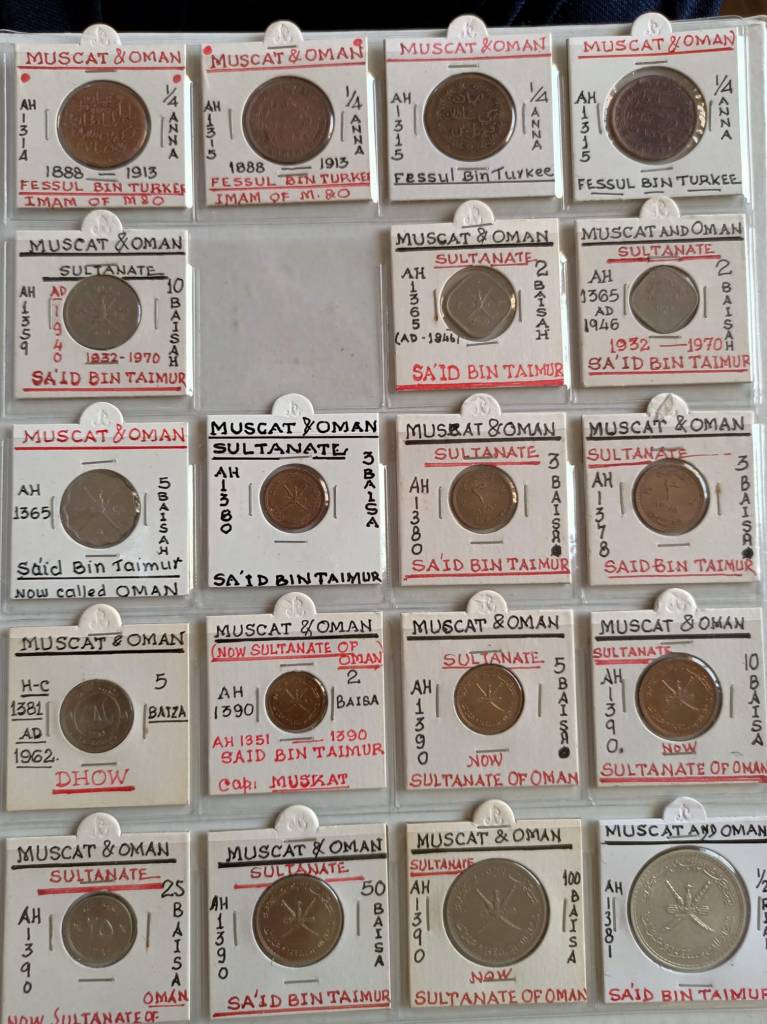
1. MUSCAT & OMAN / SULTANATE OF OMAN
Historical Background
- These coins capture Oman’s evolution from the Imamate and Sultanate period under Fessul bin Turkee (Imam of Muscat & Oman, 1888–1913) to Sa’id bin Taimur (Sultan 1932–1970).
- The currency denominations such as Anna, Baisa, and Buqsha show Indo-Arabic influence and transition from Indian currency system to independent issues.
Notable Coins
- ¼ Anna (AH 1305 / 1888 AD): Issued under Fessul bin Turkee, Indo-Arabic influence evident.
- 1, 2, 3, 5, 10, 25, 50, 100 Baisa coins (AH 1350–1390): Under Sultan Sa’id bin Taimur, many of these were minted in India and the UK, showing Oman’s modernizing economic links.
- Coin marked “Dhow” (1962): The 5 Baisa coin showing a dhow symbolizes Oman’s maritime heritage.
- The meticulous annotation “Now called Oman” reflects the post-1970 renaming and modernization under Sultan Qaboos.
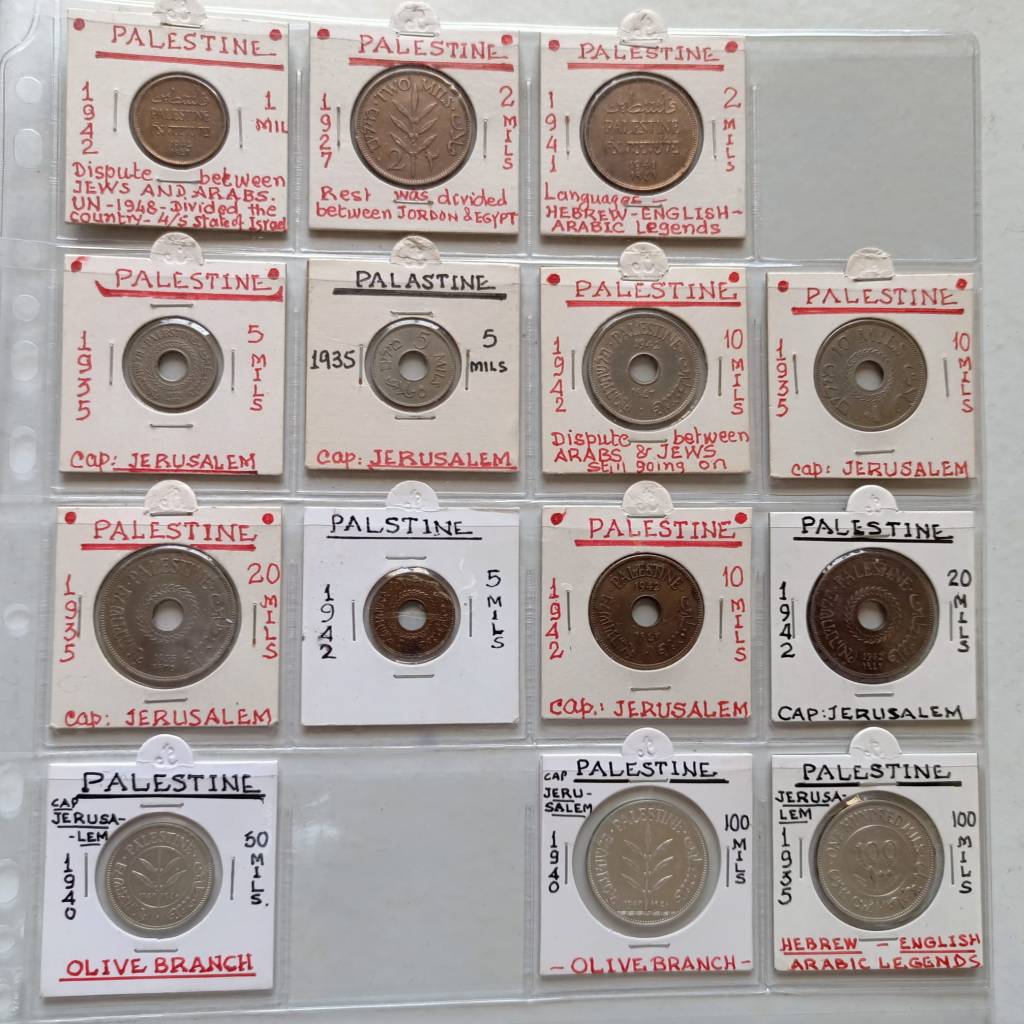
2. PALESTINE MANDATE COINS (British Mandate Era 1927–1948)
Historical Background
- These coins were issued under British rule, with legends in Hebrew, Arabic, and English.
Notable Coins
- 1, 2, 5, 10, 20, 50, 100 mils: The mil was the subunit of the Palestine pound. These coins are iconic due to their trilingual inscriptions.
- 1935, 1942, 1945 coins: Especially rare are high-grade coins from WWII years due to metal shortages.
- Olive branch emblem (50 and 100 mils): Signifies peace—symbolically rich given the region’s history.
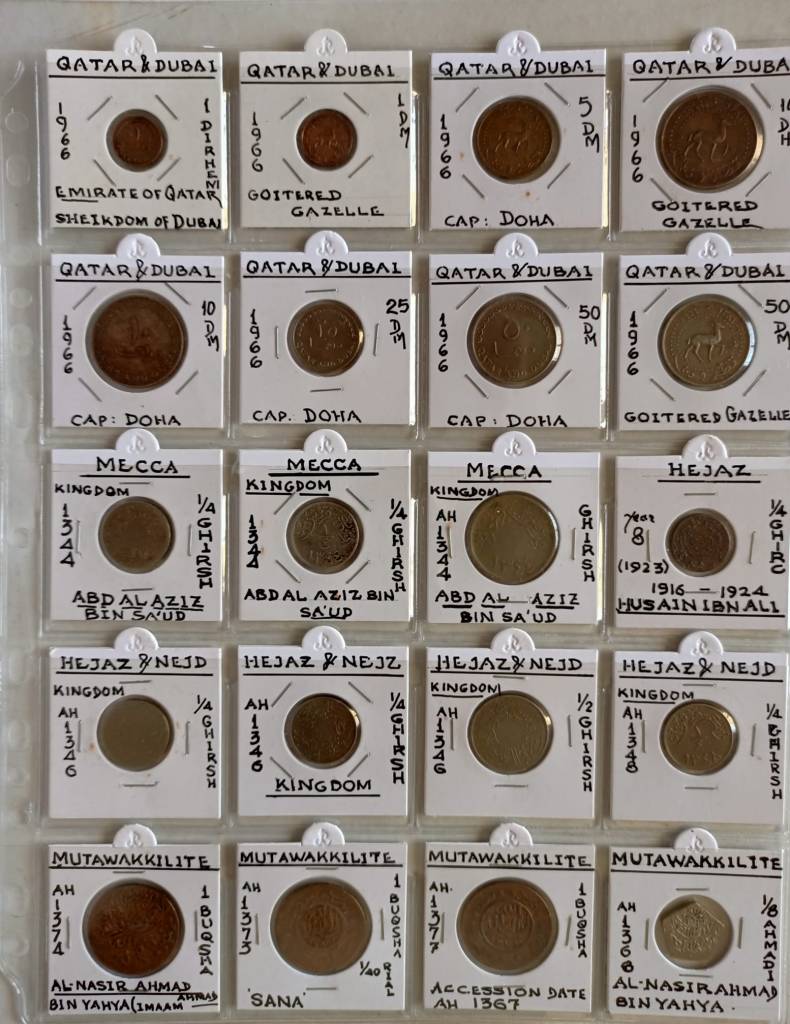
3. QATAR & DUBAI / HEJAZ / MECCA / MUTAWAKKILITE KINGDOM OF YEMEN
Historical Background
- The Qatar & Dubai currency (1966) is a brief but fascinating series prior to Qatar and Dubai joining other currency unions (e.g., UAE Dirham and Qatari Riyal). The goitered gazelle on coins is a national symbol.
- The Hejaz & Nejd coins represent pre-Saudi unification era, under Ibn Saud and Husain bin Ali. These coins often used the ghirsh denomination (Ottoman in origin).
- Mutawakkilite Kingdom of Yemen (Sana’a): These coins from the early 20th century AH 1351–1371 are scarce and show Islamic inscriptions, pre-dating the Yemen Arab Republic.
Notable Coins
- 1 Dirham (1966 Qatar & Dubai): Marked as joint currency before Qatar issued its own riyals.
- Hejaz ¼ Ghirsh coins (AH 1334–1341): Important transitional coins showing Saudi consolidation.
- Mutawakkilite Yemen 1 Buqsha: Coins of Al-Nasir Ahmad bin Yahya, many from Sana’a mint, are seldom found in such preserved state.
Key Highlights of the Collection
- Impeccable presentation: Neatly labeled with dates in both Hijri (AH) and Gregorian, mint details, rulers’ names, and even historical notes (e.g., “Now Sultanate of Oman”, “Dispute between Jews and Arabs”).
- Rare denominations: Several low-denomination coins like ¼ ghirsh and 1 mils are hard to find in good condition.
- Historical transitions: Coins reflect political shifts—from British Mandate to national currencies, and from fragmented emirates to unified nations (e.g., Saudi Arabia, UAE, Oman).
 Our Hobby Corner
Leave a comment