Author: AmitL

  • Stamps: Dad’s award winning collection

    800 Errors, One Collector, Years of Patient Research

    Today I am sharing something particularly close to my heart — a small glimpse into Dad’s award-winning philatelic collection from the 1980s and 1990s.

    This is not simply a collection of stamps.

    It is a study.

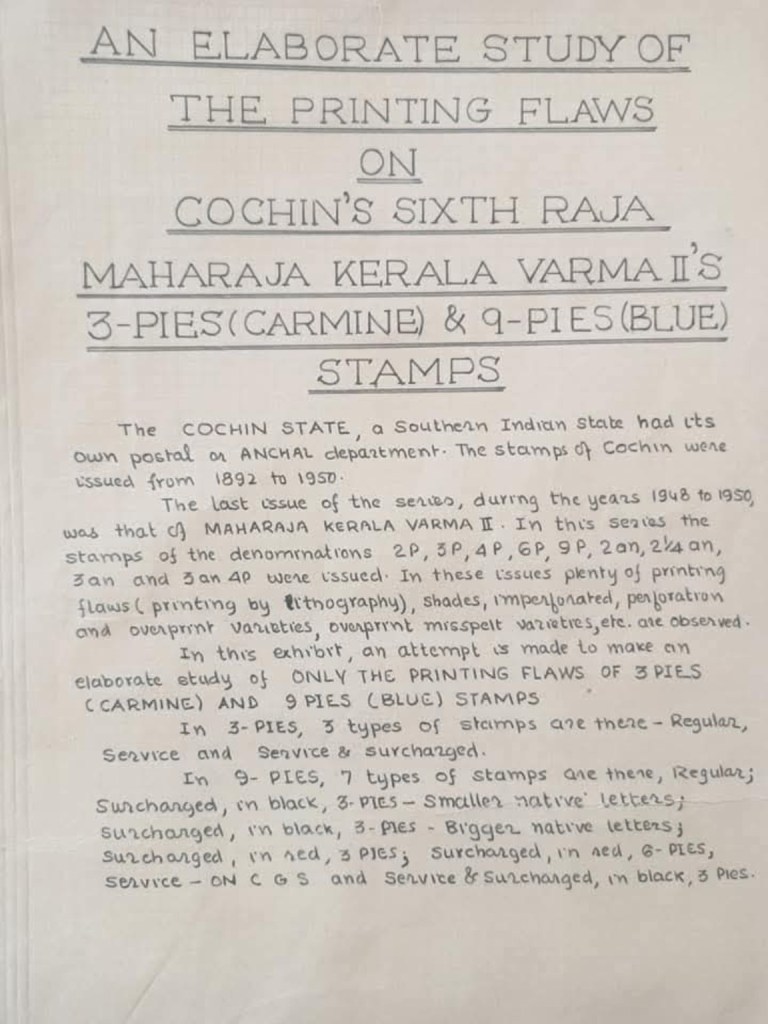
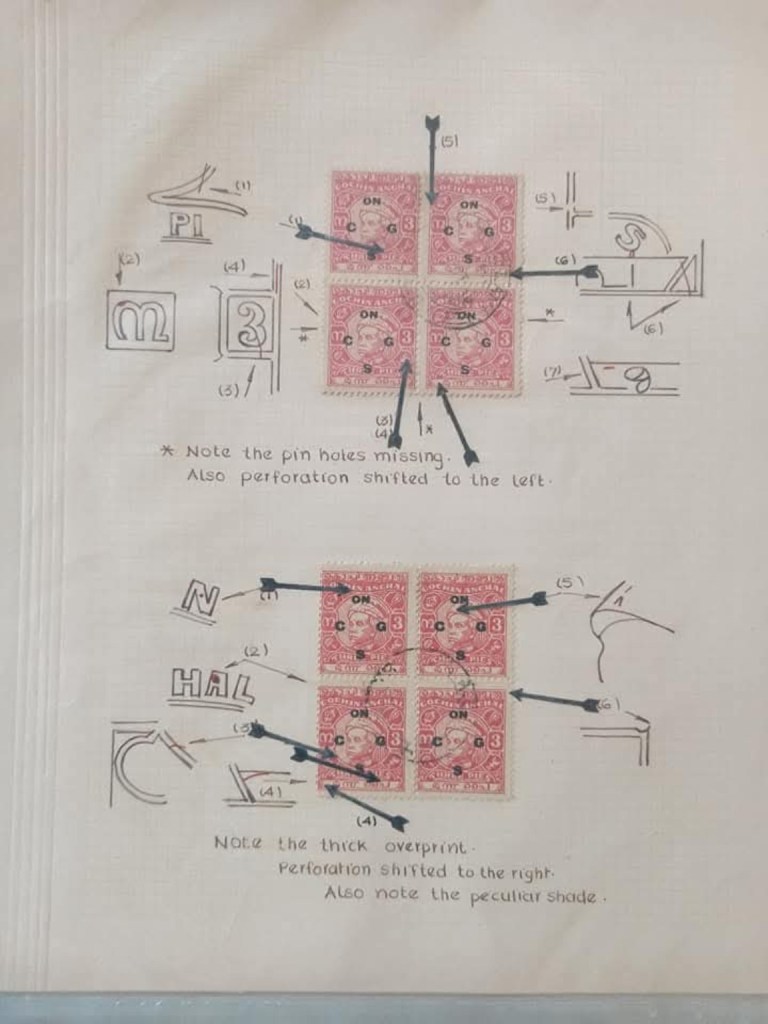
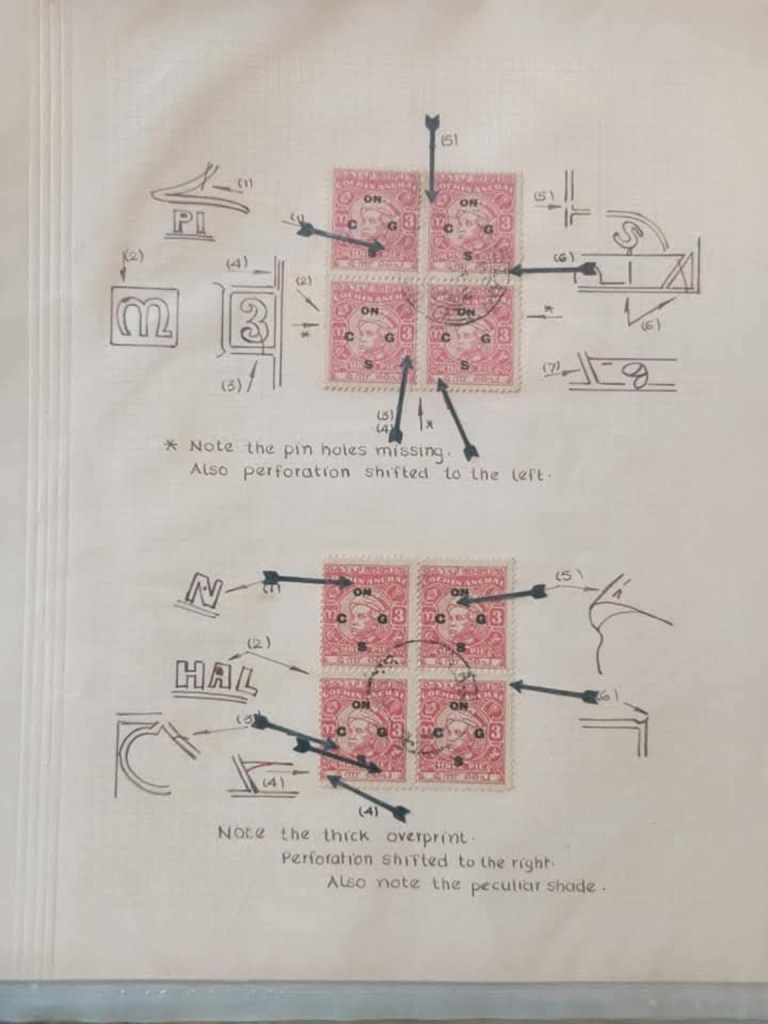
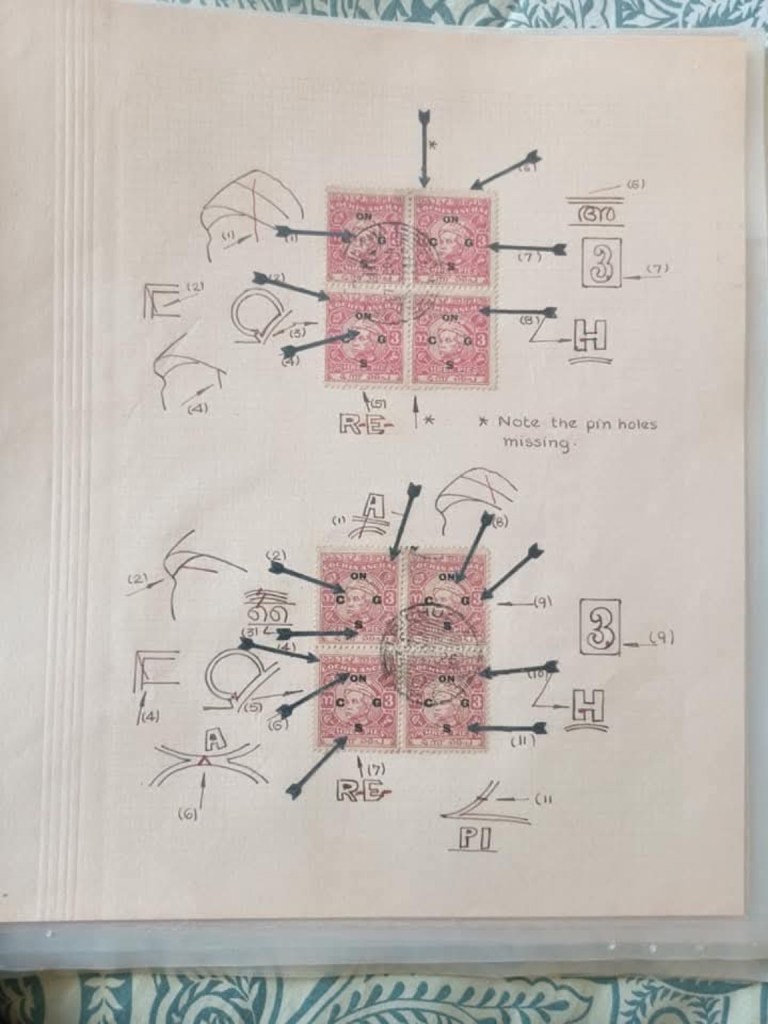
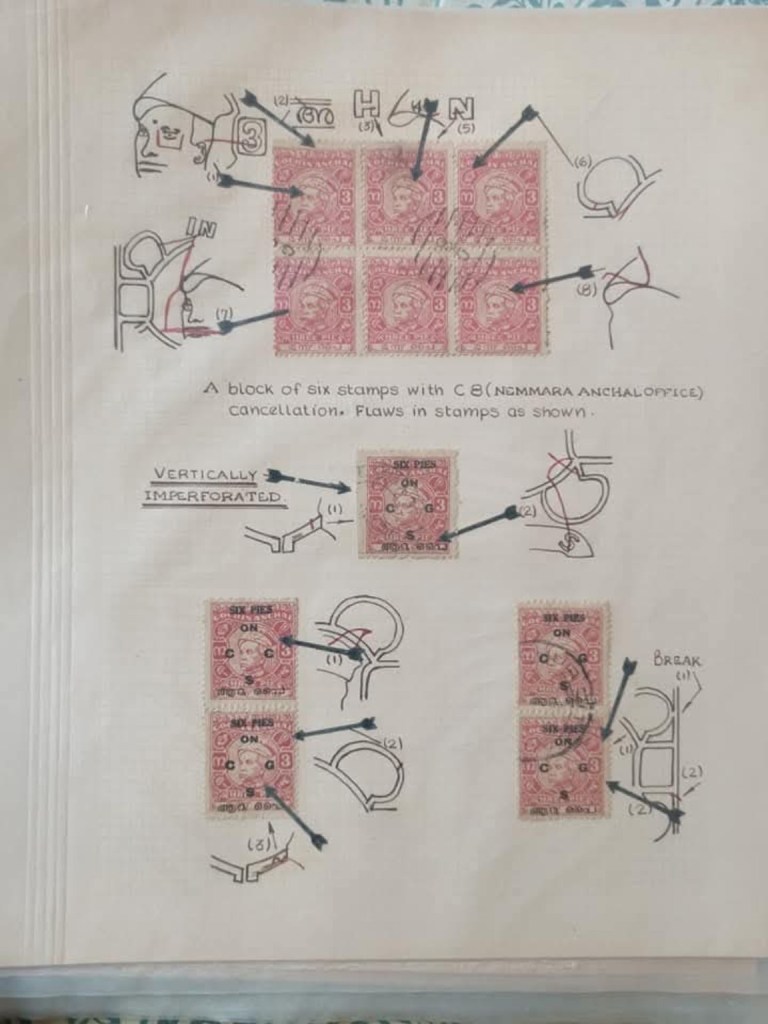
    The exhibit examines the printing flaws found on the stamps of Cochin State’s sixth Raja, Maharaja Kerala Varma II, particularly the 3 Pies Carmine and 9 Pies Blue issues.

    And when Dad called it an “Elaborate Study”, he meant it!

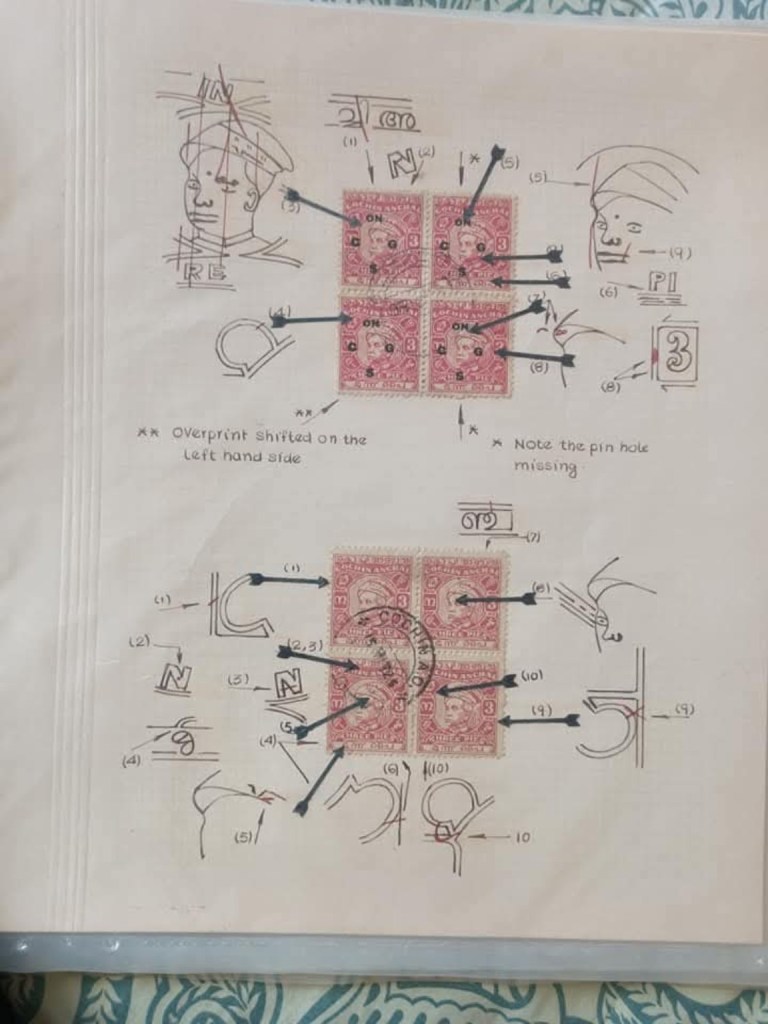
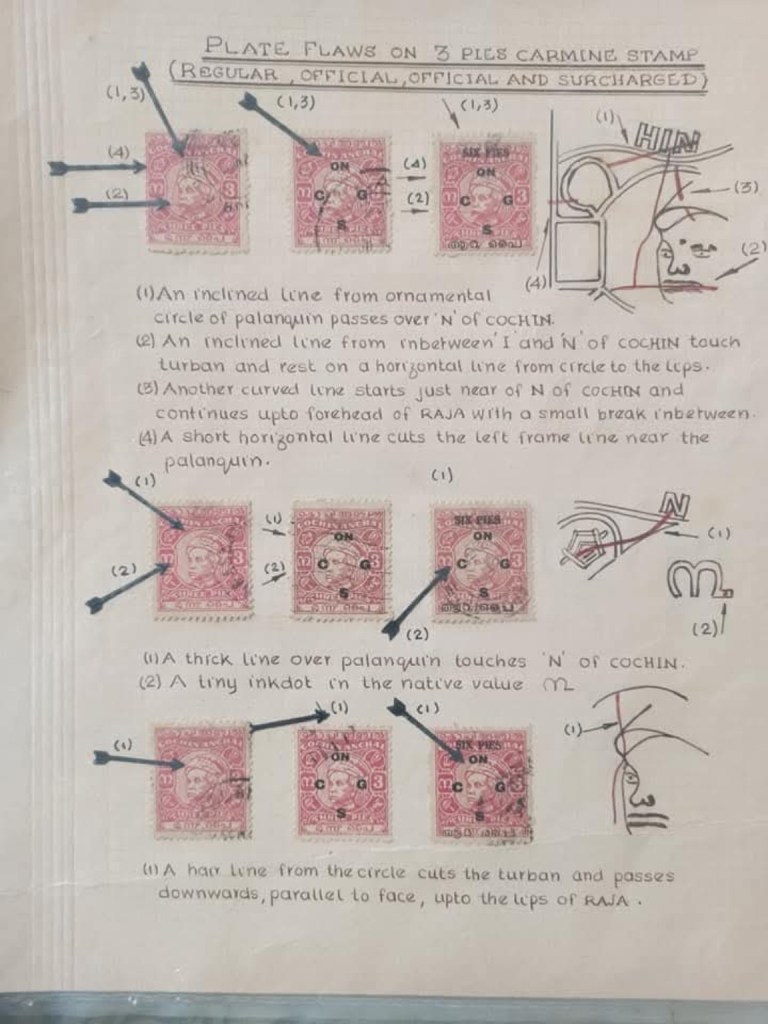
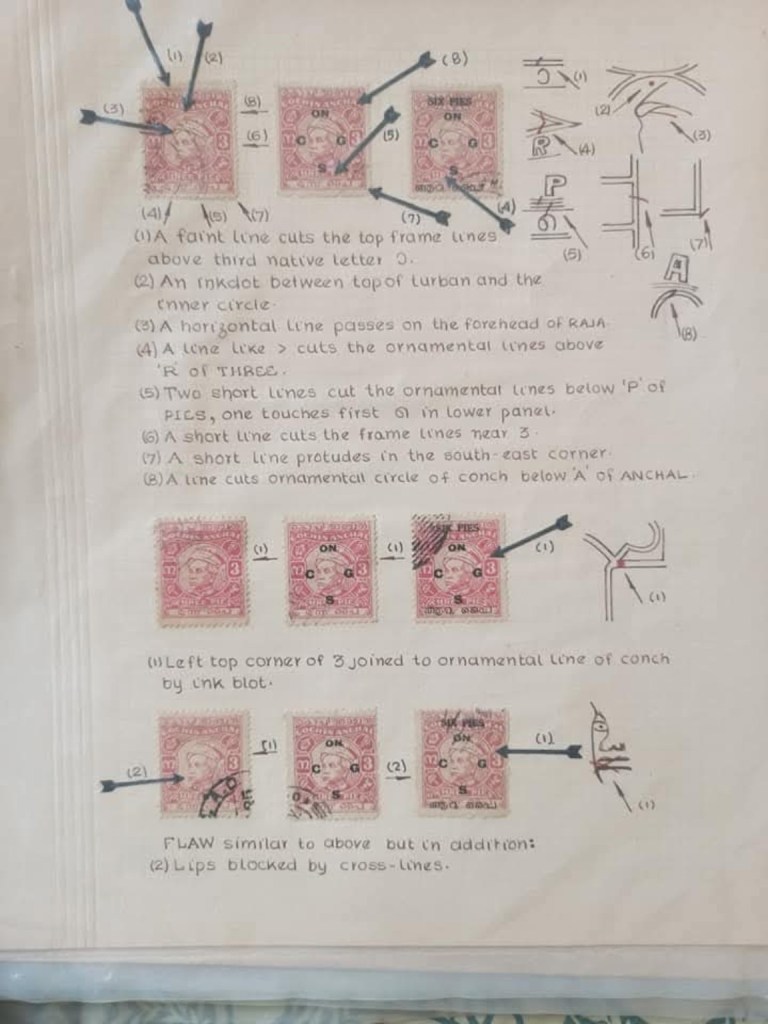
    Across the collection are approximately 800 stamps showing errors, flaws and varieties, each carefully examined and classified. (Shared here is just a small sample)

    Look closely at these pages. Every arrow, every enlarged sketch and every handwritten explanation was done by him.

    He identified minute variations that most of us would probably never notice — tiny lines through the portrait or lettering, ink dots, breaks in the design, plate flaws, shifted overprints, missing pinholes, displaced perforations, unusual shades and other printing peculiarities.

    What fascinates me most today is how this research was done.

    There was no high-resolution digital photography.
    No image enlargement on a computer.
    No online database to search.
    And certainly no AI to ask, “Spot the differences between these two stamps!” 😄

    There was instead a collector’s eye, a magnifying glass, reference material, enormous patience — and page after page of Dad’s remarkably neat handwriting and hand-drawn diagrams.

    The stamps themselves are historical objects.

    But these pages have now become historical objects too.

    They preserve not only the postal history of the erstwhile princely state of Cochin, but also the way serious philatelic research was undertaken by dedicated collectors more than three decades ago.

    And perhaps that is what makes this part of Dad’s collection especially precious to me.

    800 error stamps. Hundreds of observations. Countless hours of study. One man’s passion, preserved on paper.

    The medals and awards this collection earned are a matter of pride.

    But decades later, I think the greater treasure is being able to turn these pages and see Dad’s knowledge, patience and handwriting still speaking through them.

    A collection within a collection.

    And a family treasure beyond valuation. ❤️

    From Dad’s Collection — preserving not merely stamps, but the story behind them.

    #Philately #StampCollection #CochinState #CochinStamps #IndianPhilately #PrincelyStates #StampErrors #PlateFlaws #PostalHistory #ClassicIndia #AwardWinningCollection #CollectorsLegacy #FromDadsCollection #TimelessTreasures

  • Currency: Persian Gulf Notes

    A Persian Gulf Quartet — Finally Graded & Together

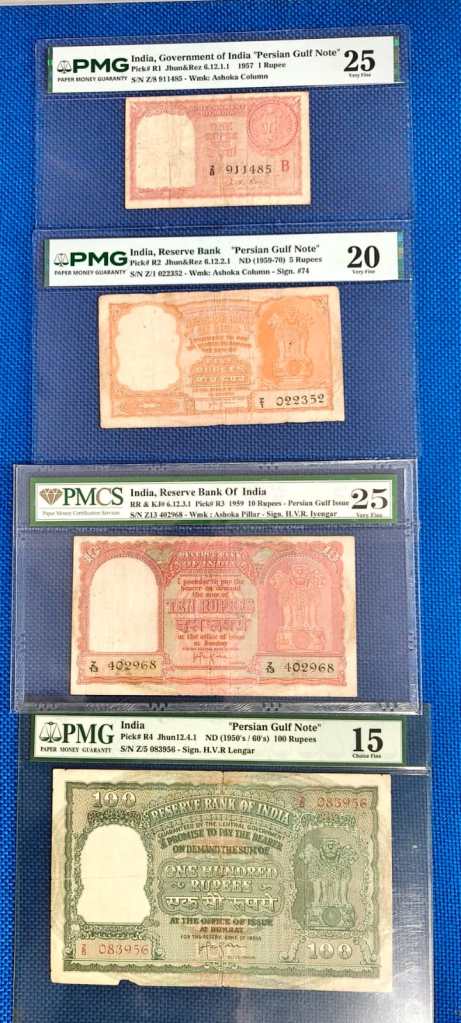
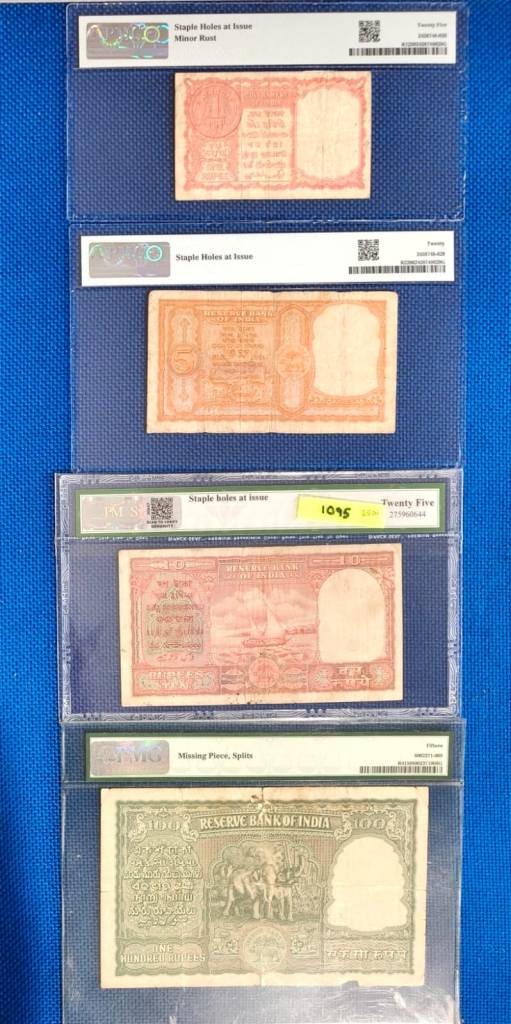
    Government of India / Reserve Bank of India Persian Gulf notes — ₹1, ₹5, ₹10 and ₹100 — are now all authenticated and graded, with the final two notes recently returning from grading.

    The grades may look modest:

    ₹1 — PMG 25 Very Fine
    ₹5 — PMG 20 Very Fine
    ₹10 — PMCS 25 Very Fine
    ₹100 — PMG 15 Choice Fine

    But with notes such as these, the number on the holder tells only part of the story.

    These are survivors of a fascinating episode in Indian monetary history.

    Introduced for circulation in the Persian Gulf region, these special Indian rupee notes are immediately recognisable to collectors by their distinctive “Z” prefix. They circulated in places including Kuwait, Bahrain, Qatar and the Trucial States — the region that would later include the United Arab Emirates.

    For someone who has spent much of his life in the UAE while retaining deep roots in India, that historical connection makes this series particularly special to me. 🇮🇳🤝🇦🇪

    And then there is the reality of collecting them.

    Finding attractive examples is not easy. These notes actually circulated, and surviving pieces often show folds, handling, staple holes and other evidence of their working life

    A pristine note is beautiful. But a circulated note can have a biography.

    Imagine where these pieces might have travelled more than six decades ago — across counters, markets and trading houses around the Gulf, passing through hands in a region that was about to undergo an extraordinary transformation.

    And today, they sit together in my collection.

    For me, therefore, this little group isn’t about chasing a 60, 65 or 67 grade.

    It is about history, survival, geography and completing a difficult set.

    The grading is simply the finishing touch: authentication, protection and preservation for the years ahead. “This set was not acquired together. I built it patiently, one denomination at a time, over the course of nearly a year. That makes seeing all four — ₹1, ₹5, ₹10 and ₹100 — finally graded and together particularly satisfying.”

    And yes… after hunting for the missing pieces and finally getting the balance two graded, there is considerable satisfaction in being able to say:

    ₹1. ₹5. ₹10. ₹100.
    Persian Gulf Issue.
    Together at last.

  • Currency Note: A Rare First Issue, Grade 67

    A ₹20 Note That Survived Half a Century in Superb Gem Condition!

    Some currency notes are collected for their age. Some for their design. And then there are notes like this—where history, scarcity and extraordinary preservation come together.

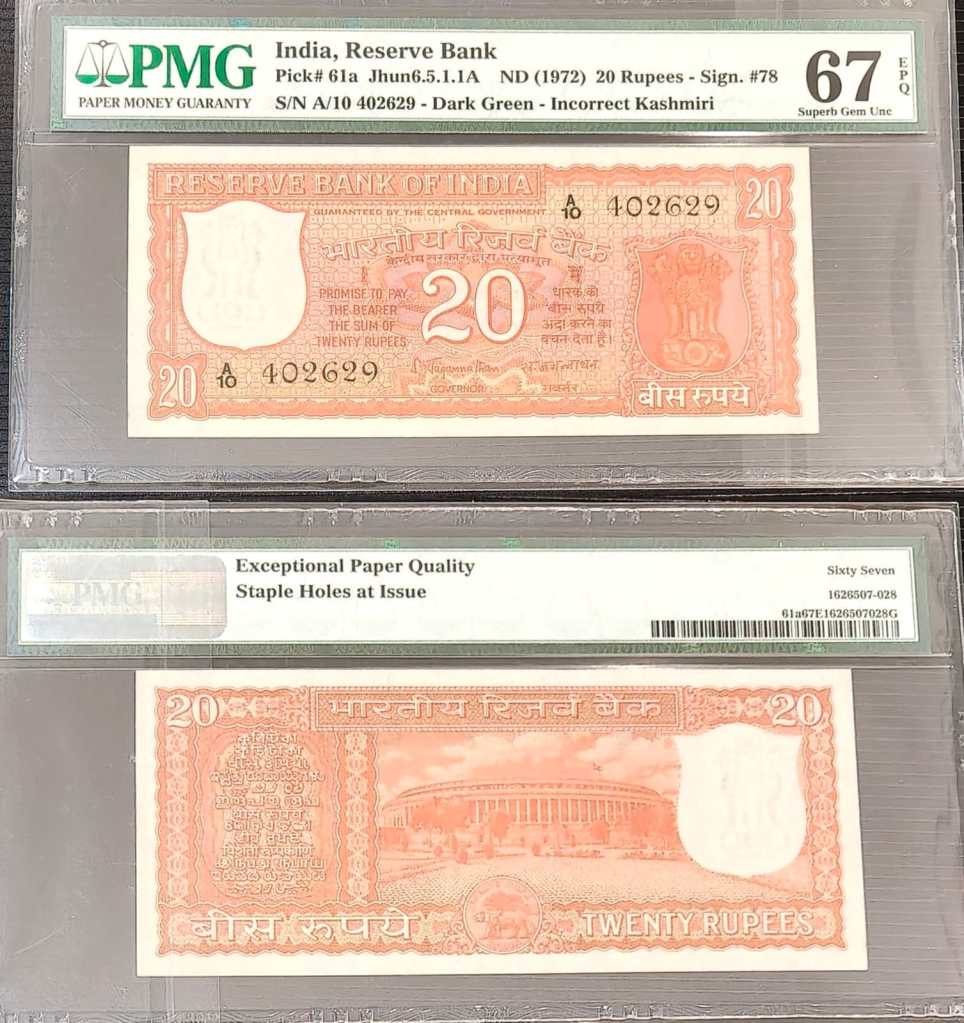
    Presented here is India’s first ₹20 banknote issue, introduced by the Reserve Bank of India in 1972. This example bears the signature of RBI Governor S. Jagannathan and belongs to the distinctive dark-green variety catalogued as Pick #61a / Jhunjhunwalla 6.5.1.1A.

    What makes it truly exceptional is its grade:

    PMG 67 EPQ — Superb Gem Uncirculated

    On PMG’s international 70-point grading scale, a grade of 67 represents a note with above-average margins, excellent registration and only the possibility of extremely minor handling. The EPQ designation—Exceptional Paper Quality—confirms that the note retains the quality and originality of its paper, without inappropriate processing or alteration.

    For an Indian banknote issued more than half a century ago, achieving this grade is quite an accomplishment. Finding an ordinary example is one thing; finding one preserved at this elite level is an entirely different treasure hunt!

    The note also carries the interesting “Incorrect Kashmiri” language-panel variety. Such details may have passed unnoticed by people using the note in daily life, but today they help distinguish important varieties for serious collectors.

    The obverse features the Ashoka Lion Capital, while the reverse depicts India’s Parliament House—making the note a miniature record of the nation’s identity and democratic heritage.

    The PMG holder additionally records “Staple Holes at Issue.” This reflects the old Indian practice of stapling bundles of banknotes before circulation. Importantly, these were recognised as occurring during the note’s original issuance and did not prevent it from receiving the magnificent grade of 67 EPQ.

    Serial number: A/10 402629
    Year of issue: 1972
    Governor: S. Jagannathan
    Variety: Dark Green – Incorrect Kashmiri
    Grade: PMG 67 EPQ, Superb Gem Uncirculated

    The ₹20 denomination was introduced partly as a cost-effective bridge between the ₹10 and ₹50 notes. Nobody handling one in 1972 could have imagined that, more than fifty years later, a beautifully preserved example would become such a coveted piece of Indian paper-money history.

    Not merely twenty rupees anymore—but a superb little survivor from another era.

    And yes, this one has earned a very special place in our collection. 😊

  • Coins: Notgeld: Graded

    Fresh back from NGC… and officially AU 55! 🎉

    One of my favourite pieces from Germany’s fascinating 1923 Westphalia Notgeld series has just returned from grading.

    1923 Germany – Westphalia 10,000 Mark (Lamb 579.7)
    Gilt Bronze
    NGC AU 55

    For anyone wondering, AU stands for About Uncirculated.

    An AU 55 coin has seen only the slightest circulation. The original detail remains remarkably sharp, with only light wear on the highest points. For a coin issued over 100 years ago, during Germany’s hyperinflation era, surviving in this condition is quite an achievement.

    What makes this medal-like Notgeld even more appealing is its beautiful gilt bronze finish, the portrait on the obverse, and the magnificent rearing horse of Westphalia on the reverse.

    Professional grading doesn’t just assign a number—it authenticates the piece, protects it permanently in a tamper-evident holder, and gives collectors worldwide confidence in its originality and condition.

    One more treasured piece safely preserved for the next generation.

    “History, now certified.” 😊

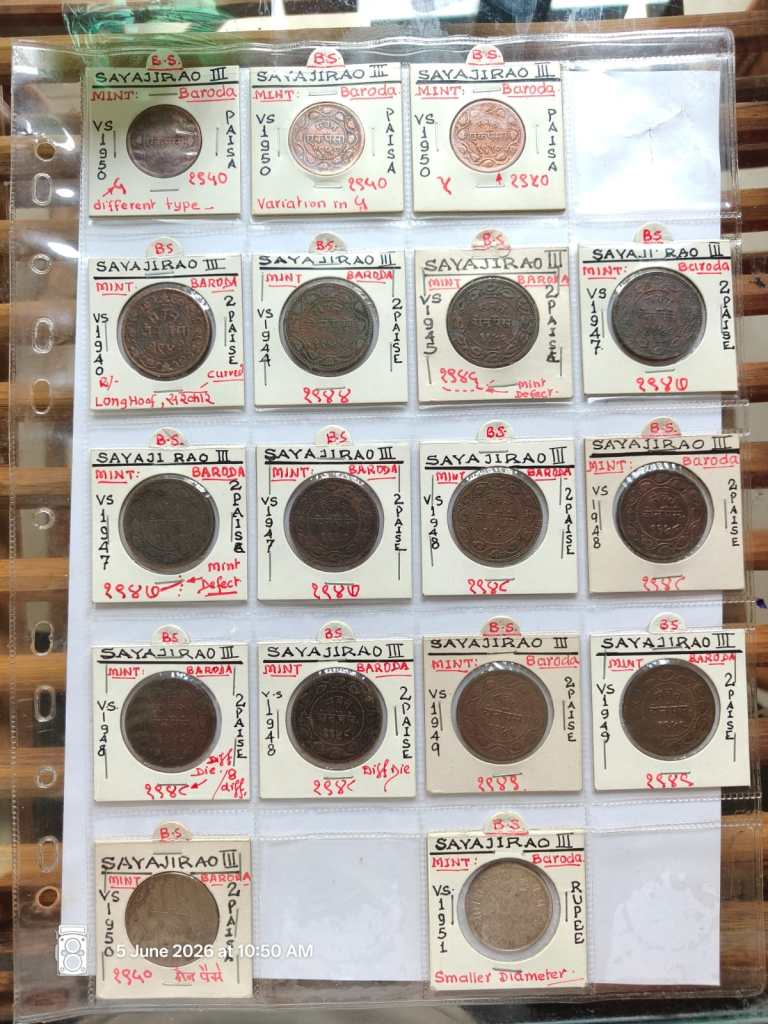
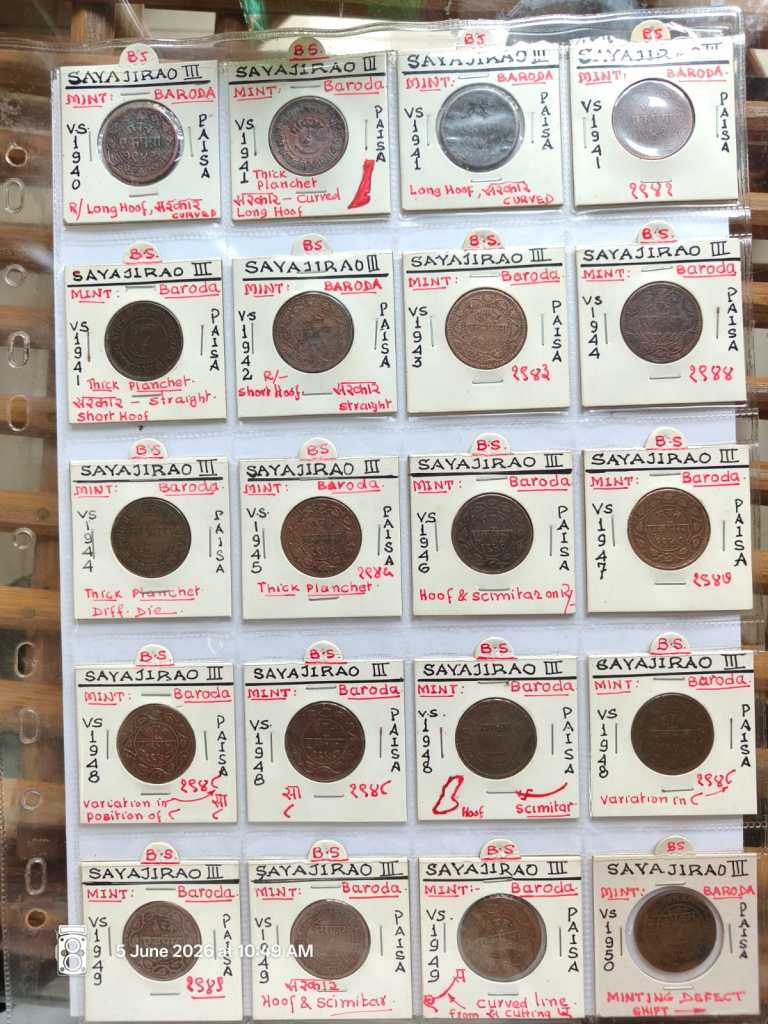
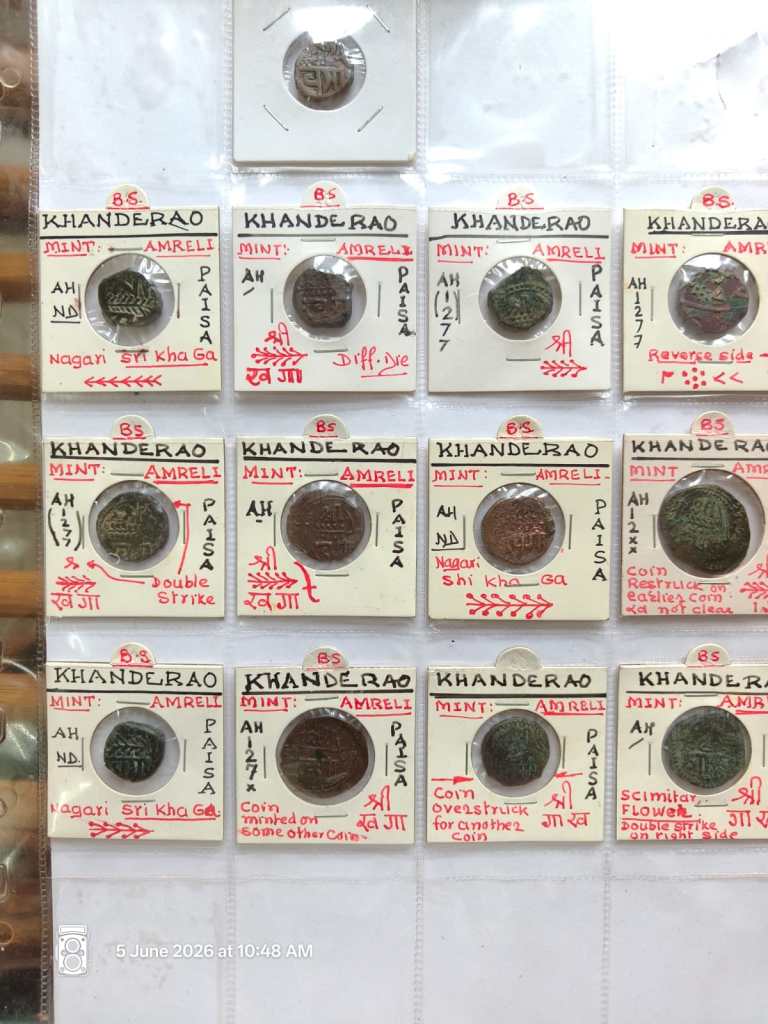
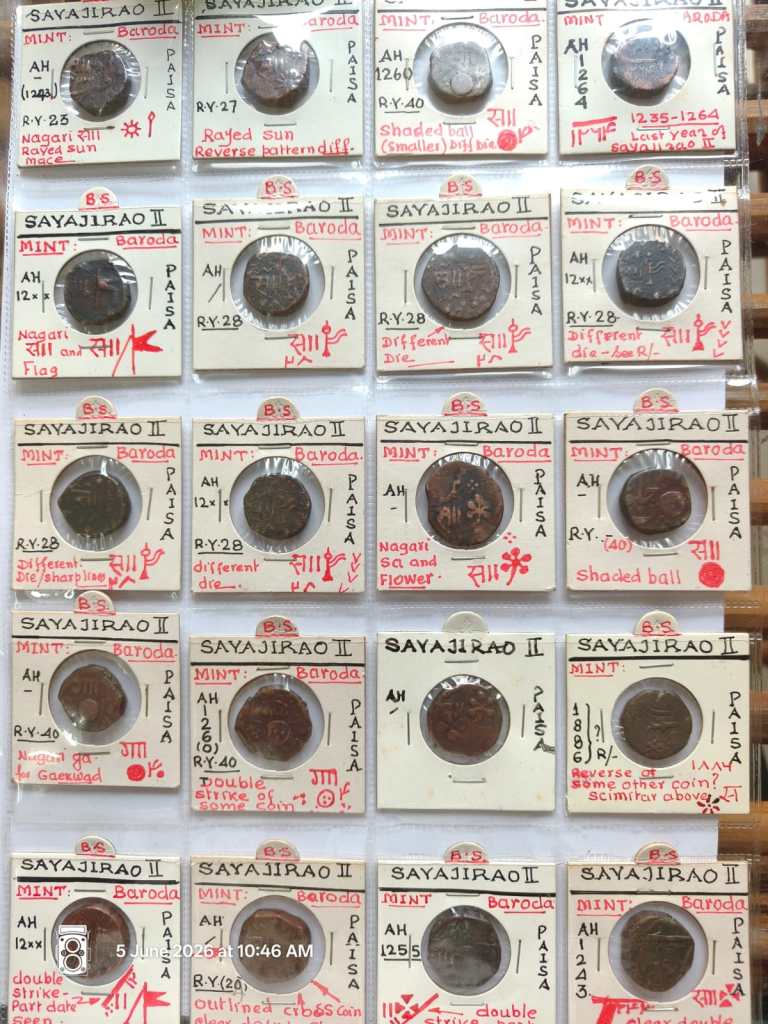
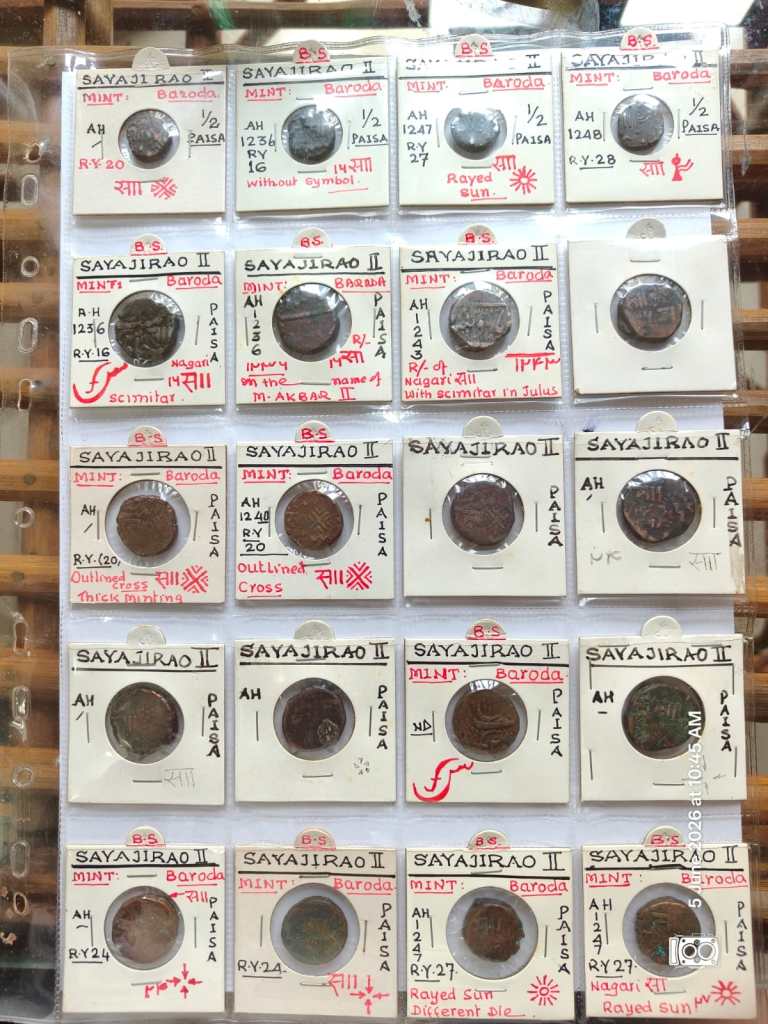
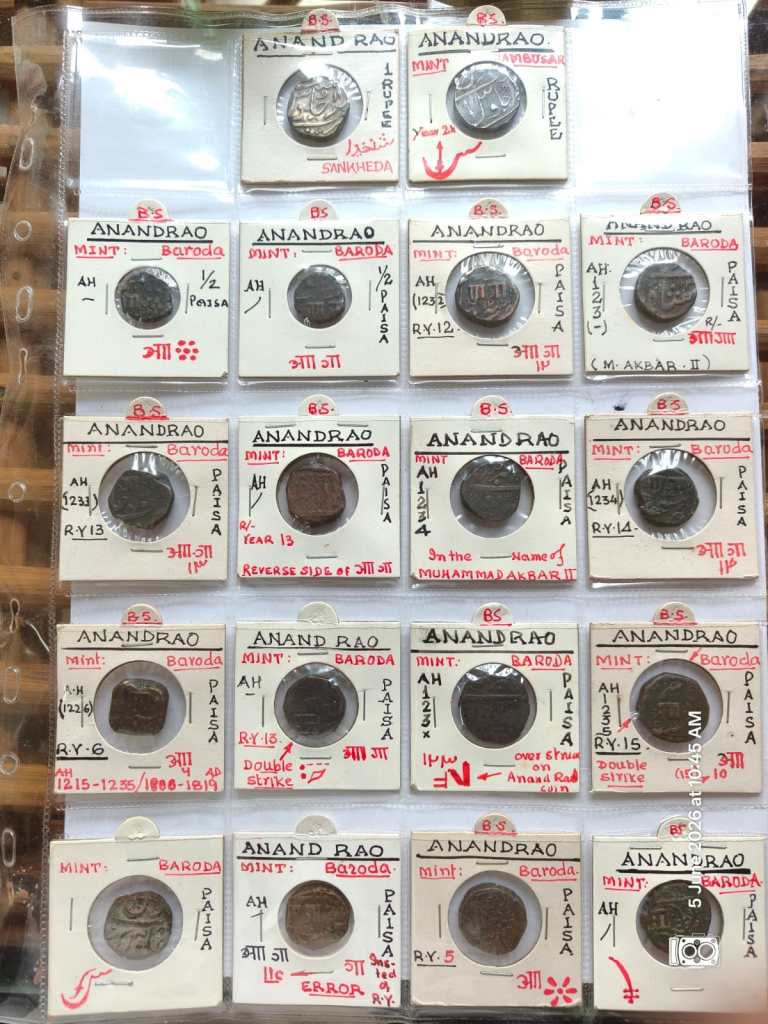
  • Coins:A Copper Chronicle of Baroda State: A selection from Dad’s Collection

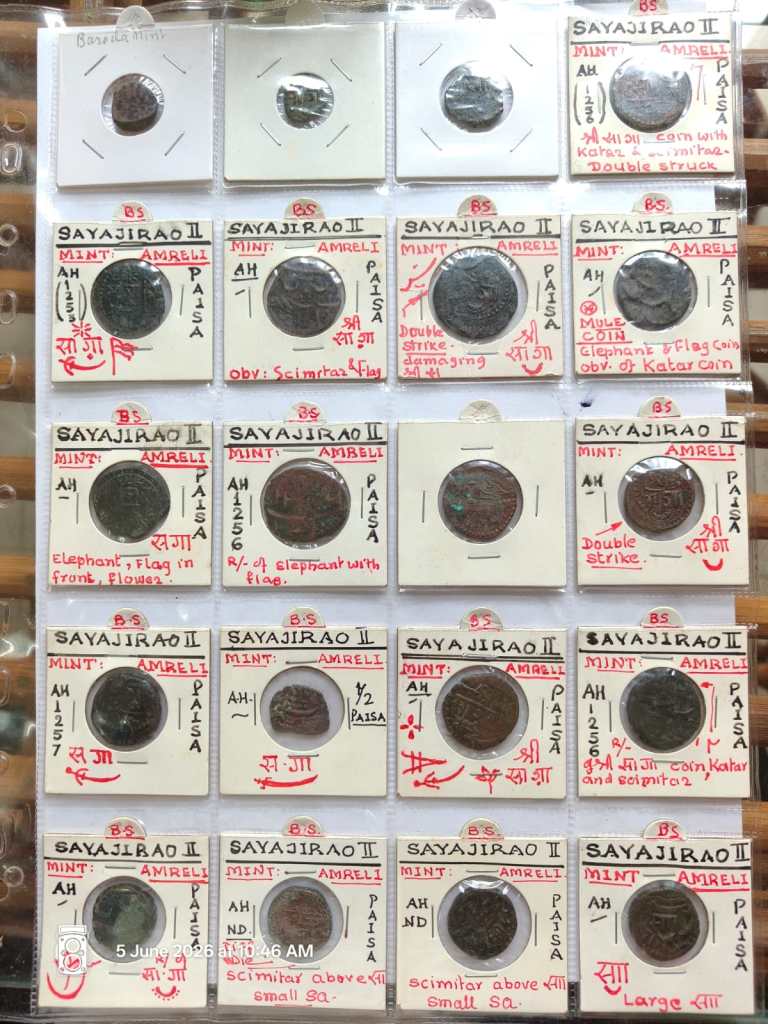
    Sharing a lovely section from my father’s collection — a specialised run of Baroda State / Gaekwad coins covering rulers such as Anandrao, Sayajirao II, Ganpatrao, Khanderao, Malharrao and Sayajirao III.

    What makes this set special is that it is not just a type collection, but a variety study collection with handwritten notes on:

    • Baroda and Amreli mint varieties
    • Nagari letter and legend differences
    • symbols like sun, flower, shield, hoof, sword/scimitar, flag etc.
    • double strikes, overstrikes, restrikes and minting defects
    • different dies, planchets, diameters and strike styles
    • the progression from early irregular copper paisa to the later machine-struck Sayajirao III coins

    I especially love the handwritten observations on each holder — almost like mini research notes. That’s the beauty of old-school collecting: not just collecting coins, but studying them, comparing them and documenting the differences by hand.

    Sharing only the fronts here, but even that gives a good glimpse into the depth of the collection.

    A wonderful copper journey through Baroda State coinage — and an even more wonderful reminder of the patience and scholarship with which earlier collectors built their collections.

  • Topic: Stamps: Thematic

    Topic: Stamps: Thematic exhibit

    🦁🦉🐘 Fun and Knowledge via the Animal Kingdom 🐒🦢🐍

    One more gem from my father’s thematic stamp exhibits…these are just a few of the 20+ sheets.

    Using stamps from around the world, he combined Animals’ Cries and English Idioms of Comparison into a fascinating educational display.

    📚 An Ape gibbbers
    🐻 A Bear growls
    🐍 A Snake hisses
    🐺 A Wolf howls
    🦢 A Swan cries

    and

    🦁 As brave as a lion
    🦉 As wise as an owl
    🐑 As gentle as a lamb
    🦚 As proud as a peacock
    🐘 As strong in memory as an elephant

    Long before Google and Wikipedia, stamp collecting encouraged children to explore animals, language, geography and general knowledge through curiosity and discovery.

    As I digitize my father’s award-winning collections, I continue to be amazed by the imagination and educational value packed into these handmade exhibit pages.

    Philately #StampCollection #ThematicPhilately #AnimalKingdom #EducationalPhilately #VintageCollections #StampExhibit #AnimalsCries #I

  • Currency note: The “Phaphda Note” — When Currency Met Culture

    Among the many treasures from the past, some stand out not just for their value, but for the stories they quietly carry.

    This ₹100 note from the Reserve Bank of India, dating back to the 50’s era of King George VI, is fondly nicknamed the “Phaphda Note” by collectors — thanks to the large watermark window that amusingly resembles the famous Gujarati snack! Signed by H.V.R. Iyengar, it’s from the AA series, i.e. an early prefix .

    But beyond the nickname lies a piece of history.
    Issued at a time when ₹100 was a significant sum, these notes were not widely circulated, making surviving examples quite special today.

    The front proudly displays the Ashoka Pillar — even before it became India’s national emblem — while the reverse showcases a majestic dam, symbolizing the nation’s early strides in infrastructure and progress.

    With its intricate design, multilingual script panel, and old-world charm, this note is more than currency — it is a snapshot of a transitioning India.

    A little worn, yes… but then again, history rarely stays crisp. 🙂

  • India in Coins – A Journey Through Time & Tribute

    From the early decades of independence to modern commemoratives, this page from the collection beautifully captures how India told its story… not in books, but in coins. ..I remember most of these coins, many were in normal use.

    Each piece here is more than currency — it’s a moment frozen in metal.

    ✨ Highlights from the Collection

    🔹 Ashoka Lion Capital Series
    A recurring symbol of India’s identity, seen across denominations — representing authority, continuity, and national pride.

    🔹 FAO Issues (Food & Agriculture Organization)
    Coins like Grow More Food and Fisheries reflect a time when India was focused on self-sufficiency and agricultural growth.

    🔹 Commemorative Leaders

    Jawaharlal Nehru

    Indira Gandhi

    Mahatma Gandhi (Birth Centenary)
    These coins are mini memorials — issued to honor leaders who shaped modern India.

    🔹 National Events

    25 Years of Independence 🇮🇳

    50 Years of Independence

    National Integration

    Asian Games

    Each one marks milestones that defined the country’s journey.

    🔹 The Classic Workhorse – 10 Paise Series
    That iconic scalloped shape — a childhood legend!
    Light in weight, heavy in memories.

    This is about about storytelling through coins:

    👉 Agriculture to industry
    👉 Leadership to legacy
    👉 Independence to identity

  • Coins: World Commemorative Coins from Dad’s Collection

    Among the many treasures in my father’s collection are these fascinating modern commemorative coins from small island territories and collector-issuing nations. Though modest in face value, they carry themes that are global in appeal — royalty, remembrance, marine life, and the art of modern minting.

    This single page brings together four very different pieces, each with its own story.

    Niue, 1 Dollar, 1997 – Princess Diana Memorial

    The first coin is a 1997 one dollar issue from Niue, a small Pacific island state in free association with New Zealand. It was issued as a memorial tribute to Diana, Princess of Wales, whose death in 1997 led to commemorative issues across many parts of the world.

    One side carries Diana’s portrait, while the other shows the coat of arms design associated with the issuing authority.

    Palau, 1 Dollar, 2001 – Marine Life Protection

    The Palau one dollar coin dated 2001 is perhaps the most visually striking piece in this group. It is a colourized commemorative coin, featuring a marine life theme, and immediately stands out for its vivid underwater design.

    Palau became well known among collectors for issuing attractive modern thematic coins, especially those linked to nature and ocean life. This piece reflects that trend beautifully.

    Nightingale Island, 1 Crown, 2005 – Queen Mother

    The 2005 one crown from Nightingale Island is another evocative modern commemorative. It features a coloured portrait of the Queen Mother and belongs to the category of collector-oriented crown issues associated with remote British island territories.

    Nightingale Island, part of the Tristan da Cunha group in the South Atlantic, is one of those names that instantly sparks curiosity. Coins from such places often appeal to collectors because of their unusual origin as much as their design.

    To summarize, these coins indicate the rise of collector-themed world issues, created as much for display and sentiment as for commerce.

    And honestly, that is part of their charm. A Pacific island remembers Diana. Palau celebrates marine life in colour. A remote Atlantic island honours the Queen Mother. Tiny coins, big geography, bigger stories.

  • Coins: The Simpsons

    Continuing the Simpsons saga..A licensed Simpsons-themed coin album, issued for modern Russian circulation coins.

    Denomination: 1 Rouble, year around 2019-2022

    Legal tender: Yes (but nobody spends these)

    Circulating coins turned into licensed pop-art collectibles.. loving this twist to our hobby… Time magazine, phone cards, coins.. all from the simpsons. Stamps next? Watch this space.