These coins are beautiful pieces from Jaipur State, part of the princely states of British India.
1. Jaipur State Nazarana Paisa (1947) Mint: Jaipur Denomination: Nazarana Paisa Year: 1947 RY (Regnal Year): 26 Ruler: Maharaja Man Singh II Notes: Nazarana coins were usually minted for ceremonial purposes or as presentation coins, often struck with special care.
1947 is historically significant as it is the year of India’s independence.
2. Jaipur State Nazarana Paisa (1941) Mint: Jaipur Denomination: Nazarana Paisa Year: 1941 RY: 20 Ruler: Maharaja Man Singh II Symbol: The scorpion symbol drawn at the bottom left is traditional in Jaipur coins, sometimes indicating mint marks or religious symbolism.
3. Jaipur State 2 Annas (1942) Mint: Jaipur Denomination: 2 Annas (Square Coin) Year: 1942 RY: 21 Ruler: Maharaja Man Singh II Note: Reference to George VI shows this was during British paramountcy, where coins sometimes bore references to the British monarch even in princely states.
These are fascinating copper coins from various Princely States of pre-independent India and neighboring regions.
1. Arcot State – Paisa Mint: Arkat (Arcot)
Metal: Copper
Denomination: Paisa
Note: Arcot was a Mughal Subah (province) and later a Nawabdom in the Carnatic region of South India. Arcot coins often feature Persian/Arabic inscriptions.
Era: Likely from the late Mughal or Nawab period (18th–early 19th century).
2. Awadh (Oudh) State – Paisa Mint: Najibabad
Date: AH 122x (Early 19th century)
Metal: Copper
Denomination: Paisa
Design Note: Features the fish symbol, a famous emblem of Awadh.
Historical Context: Awadh (Oudh) was a wealthy princely state in North India, famous for its unique coinage. Najibabad was one of its mints.
3. Bahawalpur State – 1/4 Anna (Copper) Date: 1940 AD / AH 1359
Ruler: Nawab Sadiq Muhammad Khan V
Metal: Copper
Denomination: ¼ Anna
Design: Features the portrait of Nawab Sadiq Muhammad Khan.
Historical Context: Bahawalpur was a princely state now in modern-day Pakistan. The coin shows the transition towards more modern, portrait-based coins.
4. Banswara State – Paisa (Anonymous Issue) Metal: Copper
Denomination: Paisa
Design: Features a unique symbol (resembling an ancient royal insignia).
Note: Labeled as an Anonymous Issue, meaning no ruler’s name is mentioned, common in some Rajput princely states.
Era: Likely 18th–19th century.
5. Bela State – Falus Ruler: Mahmud Khan
Metal: Copper
Denomination: Falus (an old term for copper coins)
Design: Floral or emblematic motif visible.
Historical Context: Bela was a lesser-known princely state, possibly from the Baluchistan region. Mahmud Khan was one of its rulers.
Just five sheets from Dad’s #Travancore stamps/covers collection. Each sheet is handwritten/drawn by him, when explaining the postmarks.
A fascinating aspect of Travancore’s postal history, highlighting different types of postmarks and cancellations. Here’s an overview of these philatelic gems:
The first page discusses the division of Travancore postmarks into vernacular and English groups.
A key feature is the pre-stamp circular date postmark, typically found in a rimless circle with concentric arcs.
The sample postmark from Thiruvananthapuram (Trivandrum) dates back to the pre-stamp period.
Delivery Postmarks
A postmark from Nagercoil features a double-ringed circular date stamp with “DELY.” (short for delivery).
The date format is structured with abbreviations for the month and year.
The postmark is flanked by four-pointed stars, which is a distinct design element.
Refused Mail Cancellations
A rectangular “REFUSED” cancellation appears on registered items.
The example from Chengannur A.O. is dated 27 Kar 118 (Travancore Era).
Another example from Parur A.O. is in a slightly larger rectangular format and dated 4th Thu 122.
Express Delivery (അടിയന്തിരം – “Adiyanthiram”)
Express service markings are prominently displayed.
The first example is from Ettumanoor A.O., dated 26 DHA 88.
Another example from Nagercoil, dated 29 VRI 105, shows a similar rectangular marking.
Express Service Markings of Travancore
This marking is divided into three sections, with “ATIYANTRAM” (Express) at the top.
The middle sections contain words like “SAMAYAM” (Time), “MANI” (Hour), and “MINITTU” (Minutes).
English versions of these markings are also seen on registration slips.
A collection of Dhar State coins, specifically Paisa coins, from Dhar, a princely state in central India (now part of Madhya Pradesh).
Historical Background of Dhar State Coins:
Dhar State was a princely state under British India, and it issued its own coinage before the introduction of the Indian rupee.
Coins from Dhar are known for their unique designs, often featuring Hindu mythological figures.
The collection particularly highlights coins with Hanuman depictions, which were significant in Dhar’s local culture.
Details:
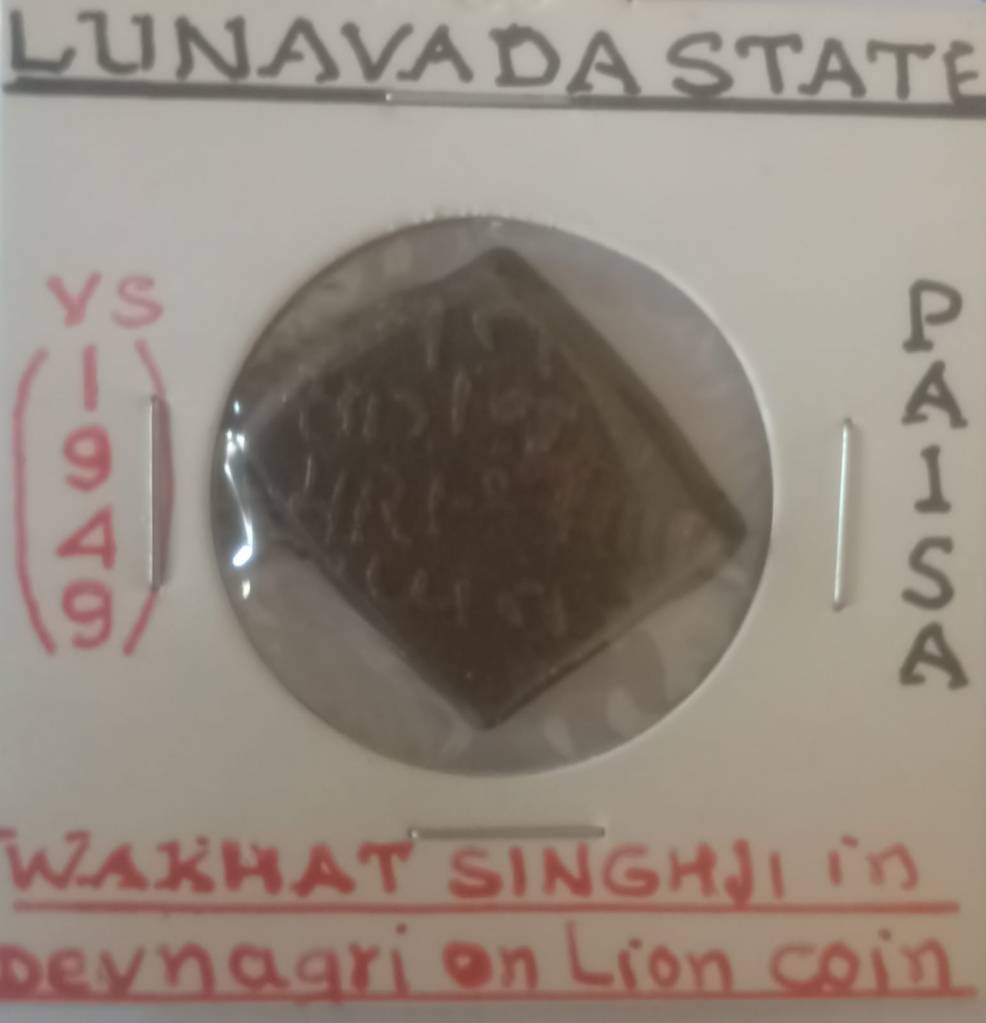
The coins are labeled “DHAR STATE PAISA”, indicating their denomination and origin.
Some coins are marked with “Hanuman”, suggesting they feature the image of the Hindu deity Lord Hanuman.
There are references to “Die Variation Hanuman”, which implies there are different versions of the same coin with slight differences in die design.
Some labels mention “Square Planchet”, meaning a few coins were struck on square-shaped metal blanks rather than the standard round shape.
The handwritten red Hanuman figure on the holders further suggests a thematic focus on the Hanuman imagery.
Why Are These Coins Important?
Cultural Significance – Dhar State coins featuring Hanuman reflect the regional religious influence and devotion to the deity.
Numismatic Rarity – Variations in the dies and planchets (e.g., square coins) make them valuable to collectors.
Historical Context – These coins were issued in a period when princely states had their own monetary systems before Indian unification.
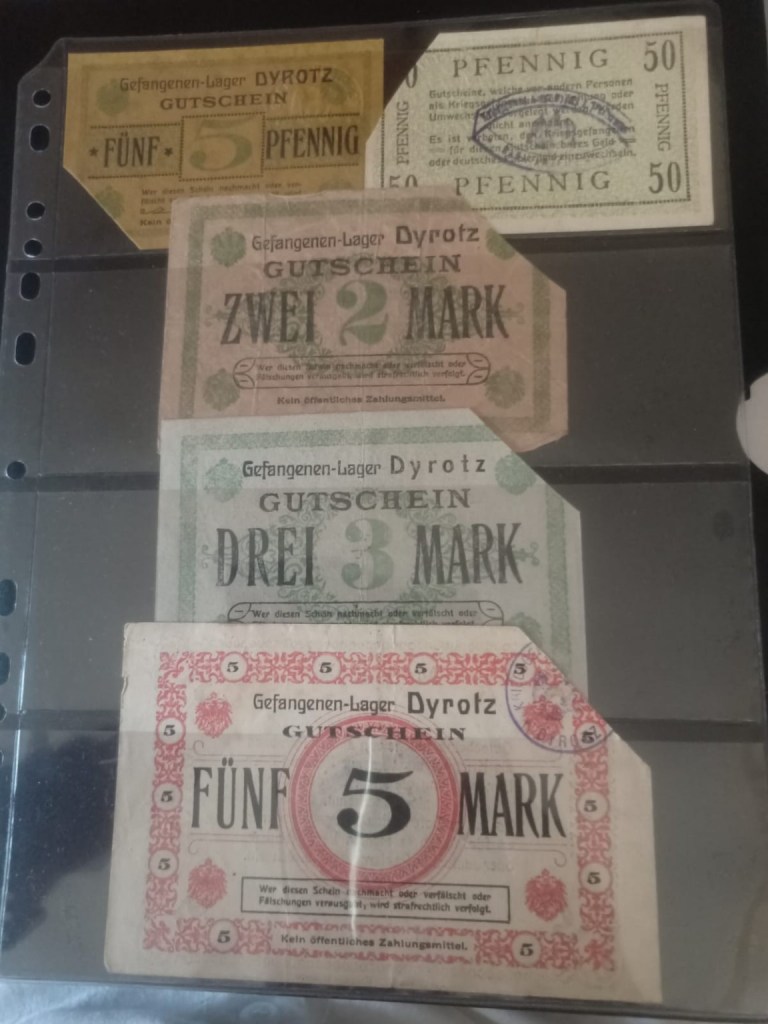
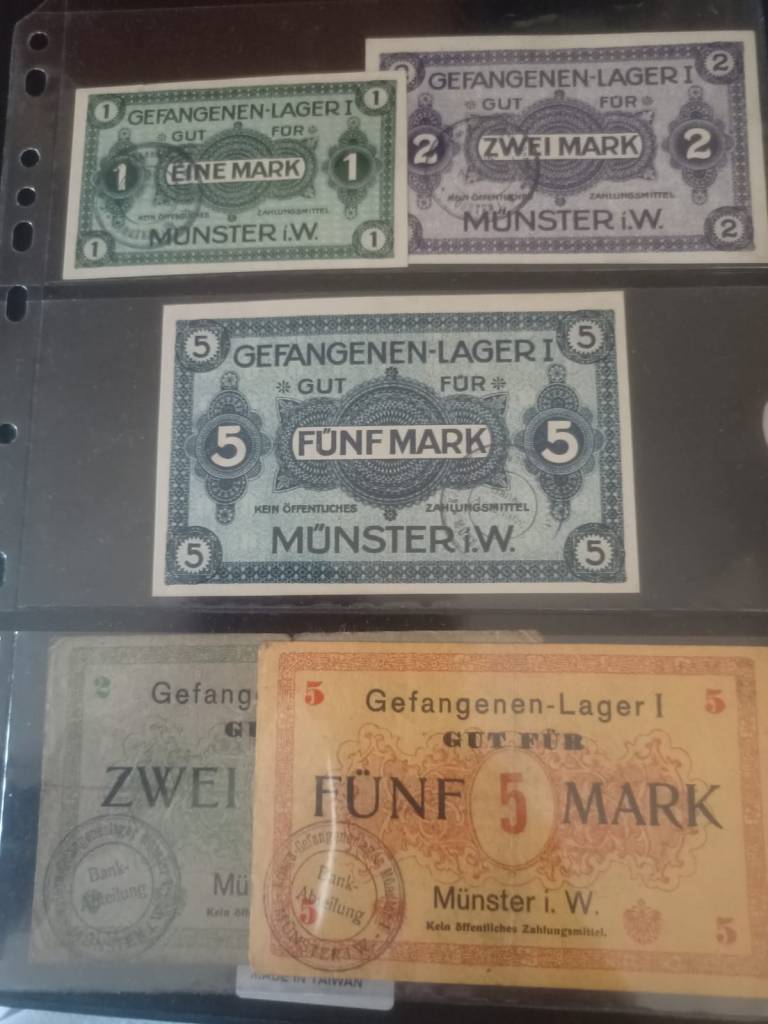
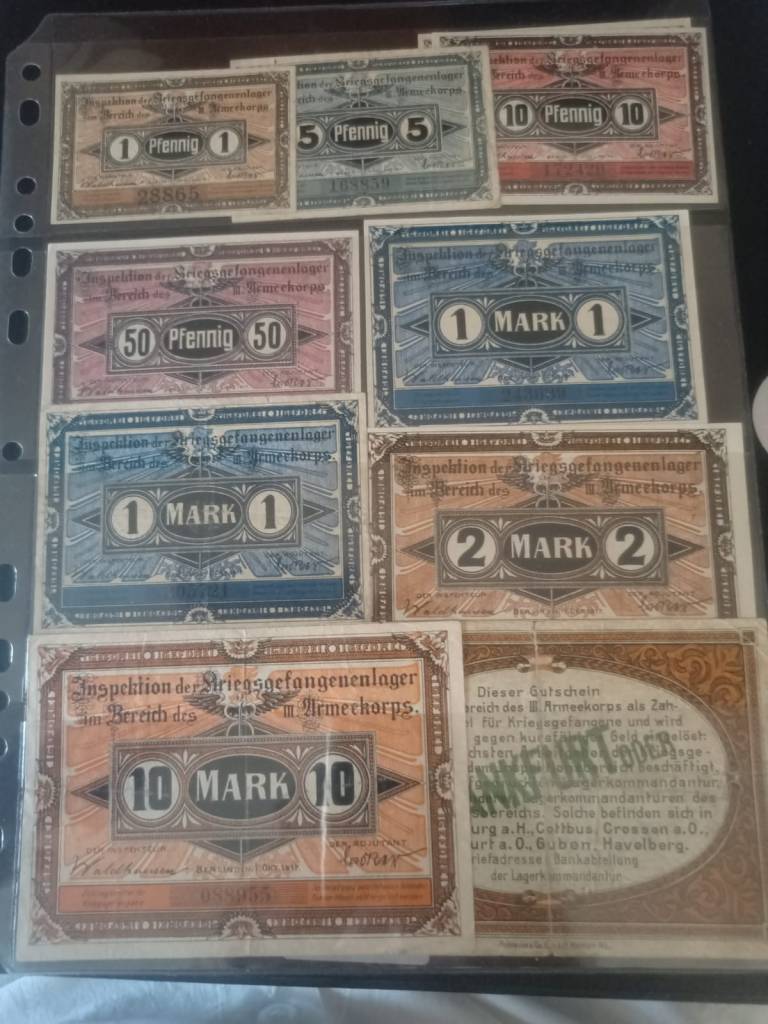
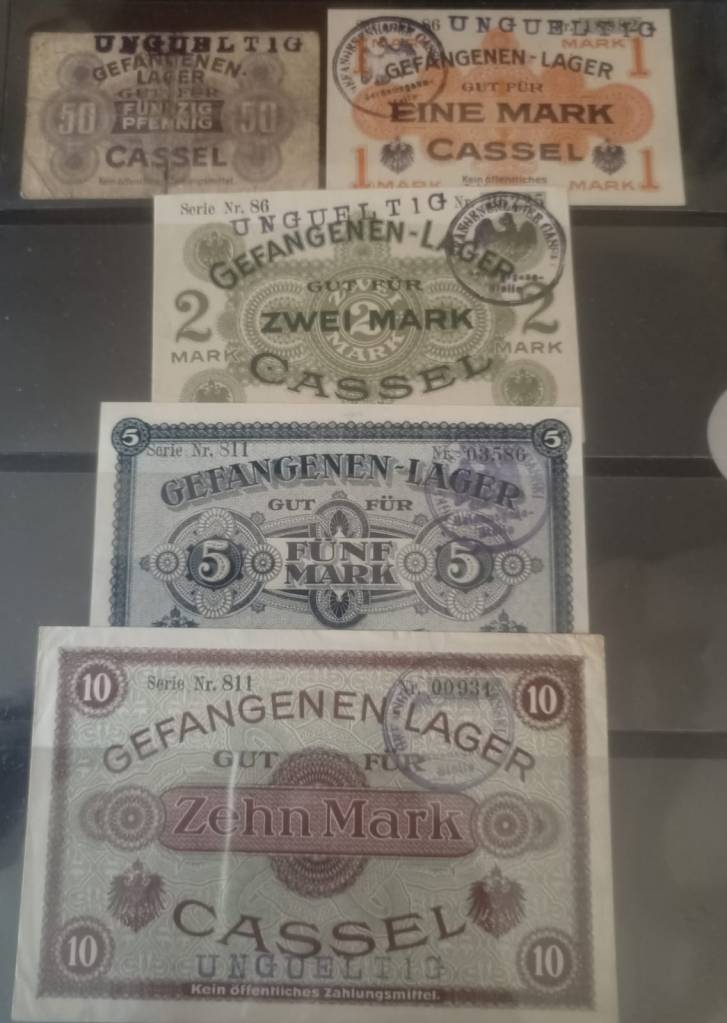
These are Notgeld (emergency money) issued for the Gefangenen-Lager Dyrotz, a prisoner-of-war (POW) camp in Germany. Notgeld was commonly issued during times of economic crisis, especially during and after World War I, when there were shortages of official currency.
Key Features of These Notgelds: Issued by Gefangenen-Lager Dyrotz
Dyrotz was a POW camp, likely in Germany, where these notes were used internally for transactions among prisoners. They were not public legal tender (as indicated on the notes: Kein öffentliches Zahlungsmittel). Denominations and Design
The notes in the image include different values: 5 Pfennig, 50 Pfennig, 2 Mark, 3 Mark, and 5 Mark. Each note has decorative borders and the term Gutschein, which means “voucher” or “coupon”. Some have official stamps or markings, which could indicate validation for circulation within the camp. Security and Warning Text
These notes carry a warning: Wer diesen Schein nachmacht oder verfälscht oder Fälschungen versuht, wird strafrechtlich verfolgt. Meaning: “Whoever forges or falsifies this note or attempts counterfeiting will be prosecuted.” This suggests they were carefully controlled within the camp system.
Historical Context:
During WWI and WWII, many POW camps issued their own Notgeld to control economic activities within the camp, preventing prisoners from using official currency. These types of notes were often exchanged for goods in camp canteens but had no value outside the camp. Collectibility & Value: These POW camp Notgelds are rare and highly collectible, especially if they are in good condition and have clear stamps or signatures.
‘Pride of our U.A.E. coin collection’, I’d say.. a beautiful set, two with PF 69 grading, one with the highest, PF 70.
This beautiful seven-coin silver set, in a super gift box, was released in 2021 to celebrate the nation’s 50th anniversary and pay tribute to the founding fathers. Each coin in this set features a black-and-white image of a founding father alongside a color image of a current member of the Supreme Council of the Union. Only 3,000 of these sets were made available to the public.
Below: A closer look in two parts, at the seven coins, one for each Emirate, in the series.
• Featured today: coins representing the rich history of Indian princely states before and during British rule.
1. Awadh State Coin
• Period: 1263-1272 (Islamic calendar, likely 1847-1855 AD)
• Mint: Lucknow
• Ruler: Wajid Ali Shah (the last Nawab of Awadh)
• Details: This coin was issued during the rule of Wajid Ali Shah, the last ruler of the Awadh kingdom before its annexation by the British East India Company in 1856.
2. Bajranggarh State Coin
• Issued in the name of Jai Singh
• Details: Bajranggarh was a small princely state, and this coin was likely minted in a local or regional style.
3. Bindraban State Coin
• Mint: Bindraban (Vrindavan)
• Islamic Year: AH (Anno Hegirae)
• Ruler: Not specified
• Details: Bindraban (modern-day Vrindavan) was a prominent religious and cultural hub during the Mughal and British periods.
4. Dholpur State Coin
• Mint: Dholpur
• Reign Year: RY 17
• Ruler: Kirat Singh
• Details: Dholpur was a princely state in present-day Rajasthan, and this coin was likely issued during Kirat Singh’s rule.
________________________________________
5. Bikaner State Coins
• Coin 1 (1892)
o Ruler: Ganga Singh Bahadur
o Inscription: Mentions Victoria Empress
o Details: This coin signifies the relationship between Indian princely states and British rule.
• Coin 2 (VS 1994)
o 50th Anniversary of Ganga Singh Bahadur’s reign
o Details: This commemorative coin marks an important milestone in his rule.
________________________________________
6. Hyderabad State Coins
• Mint: Hyderabad
• Coin 1:
o Reign: Mir Usman Ali Khan (last Nizam of Hyderabad)
o Distinct Feature: Depiction of Charminar on one side.
• Coin 2:
o Reign: Mir Mahbub Ali Khan
o Details: Hyderabad was one of the most powerful and wealthy princely states under British India.
________________________________________
7. Mewar State Coins
• Mint: Udaipur
• Coin 1 (VS 1985)
o Inscription: “A Friend of London”
o Details: This could indicate British influence in the region.
• Coin 2:
o Design: Chitrakut Udaipur (depicting a scenic view of Udaipur)
o Details: Mewar, centered around Udaipur, was a historic Rajput kingdom known for its fierce resistance against Mughal and British rule.